
Laying up (or winterizing) a cooling tower properly is important because stagnant water can lead to problems such as corrosion or fouling. A misconception is that you only need to worry about this during the hot months of the season when the cooling tower is running. Water and the iron metal present in cooling tower surfaces will react and form corrosion. Additionally, fouling occurs because bacteria thrive in stagnant water, due to there being no flow to disrupt their growth.
The worst thing you can do is to leave your water full, especially without treatment. Chiller end bells, tube sheets, and condenser water pipes will develop corrosion problems that will lead to mill scale, pitting, and ultimately failure. Mill scale builds up and eventually flakes off and collects in tower distribution pans as rust chips. These rust chips can cause cooling tower distribution pans to overflow, resulting in reduced cycles of concentration, increased water usage, accelerated corrosion rates, and ultimately shorter equipment life.
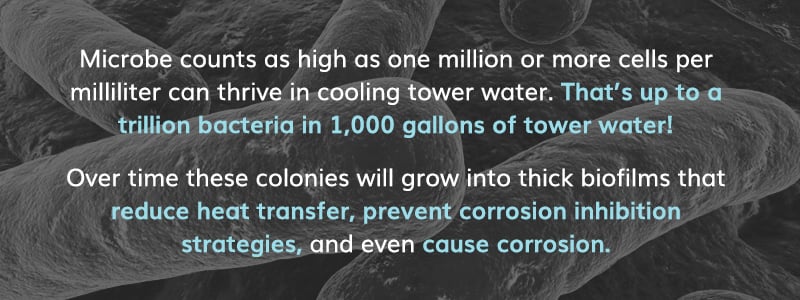
Bacteria and algae can rapidly grow and become quite resistant to cleaning and treatment. This is because as the problem worsens, biofilm spreads and makes it difficult to quickly eliminate. One of the worst aspects about bacteria growth in a cooling tower is the spread of Legionella Pneumophila. If the cooling tower is not treated or tested, this is a bacterium that can aerosolize and cause a deadly pneumonia-like sickness called Legionnaires’ Disease. Due to this, it is important to consider the cleanliness of your cooling tower water when it is laid up.
Another problem facing cooling towers when not properly laid up is under-deposit corrosion.
There are several types of under-deposit corrosion. Calcium carbonate, calcium sulfate, and other minerals are always dissolved in water unless removed. (Think about unsoftened tap water or mineral water from the store). These minerals will deposit over time, especially in stagnant water. Anode/cathode corrosion will occur because of little oxygen reaching under the scale (anode) and due to a larger amount of oxygen outside of the scale deposit (cathode).
In addition to scale, there are certain types of debris that can enter the tower, especially if left alone for a season. For example, sediment brought in by air pulled through by the tower fan accumulates in the tower sump. This is part of the normal operation of a cooling tower, and the quantity deposited depends on the air quality, location of the tower, load, and run time of your equipment. As deposits accumulate in the tower sump, they create electrolytic corrosion cells and barriers to chemical passivation that can accelerate the corrosion rate and decrease the life cycle of the cooling tower.
There is a right and a wrong way to layup your cooling tower. It is an annual task that takes place at the end of the cooling season. The most important aspect of it is draining the system. Two weeks before shutting down and draining your cooling tower, you must adjust your cycles of concentration. Cycles of concentration describes the number of times water will circulate through your cooling tower before being drained. You will want to decrease your cycles by 50% in order to remove solids and suspended matter more effectively. (Essentially, there will be more chemical and fresher water with a lower chance of unwanted minerals, organic matter, or other contaminants).
A few days before shutdown, it is recommended to feed passivation, inhibitor, and biocide chemicals. Circulate this for 1 to 2 days. Afterwards, drain and clean the system. Make sure to remove any solids still present, especially in the pump. Ideally, you would clean the system biannually.
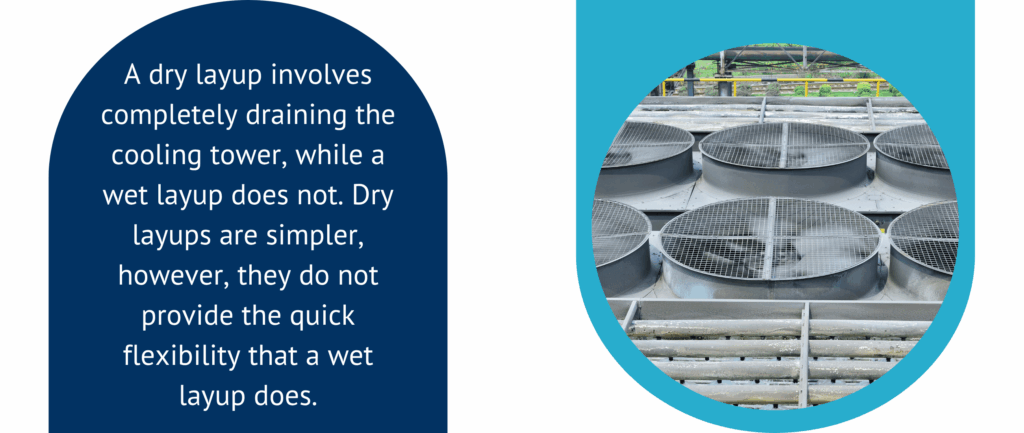
A dry layup is what was described in the previous 2 paragraphs. After treating properly with chemicals, you completely drain the water out of the system. A wet layup differs from this as you do not leave the system drained after draining the water with the steps of a dry layup. You will treat and refill the system. As part of your treatment, you will want to introduce inhibited glycol to prevent freezing for colder months. Now that you have a full system that is not operating, you will need to take additional measures to prevent stagnation and the issues that come with it. You will need to circulate the water twice a day. Additionally, chemicals degrade over time even if they are not being flushed or introduced to new water. Because of this, you will need to feed chemicals to replace the degraded chemical.
The Cooling Tower Institute, ASHRAE, Chardon and other professional organizations have identified a population level of 105 CFU/mL* or lower as efficient. Bacteria are over 98% water and do not impact evaporation or heat transfer as free-floating cells. When the population exceeds the carrying capacity of the environment, bacteria secrete a coat of extracellular polymer, better known as slime.
This slime traps other particulates, harbors both living and dead bacteria, and eventually grows into a complex community known as biofilm. Biofilm has an insulating effect on heat transfer, can clog piping and reduce flow rates, and can promote corrosion beneath the biofilm by a variety of mechanisms. If left to grow out of control, biofilm will support rich, complex communities that may include multicellular organisms such as rotifers and roundworms.
Biofilm forms a boundary between the water and the copper and steel in your tower and heat exchangers. Chardon has found that this boundary reduces heat transfer efficiency. In fact, biofilm creates even more heat transfer problems than calcium scale. Biofilm also prevents corrosion inhibitors from reaching the base metal. Biofilm can harbor Legionella and other potentially harmful species that require water treatment.
Microbiologically influenced corrosion, or MIC, can occur within biofilm and attack tube sheets, end bells, and other system components that are protected during normal tower operation. Biofilm also supports under-deposit corrosion that can weaken metal components and shorten equipment life.
Chardon knows that algae can be a problem in cooling towers where a significant amount of sunlight reaches the water. Much like bacteria, though, a little algae in the sunlit parts of a cooling tower does not reduce evaporation or heat transfer. Thick mats of algae can promote under-deposit corrosion and harbor other damaging bacteria. Long strands of algae that break free can clog strainers or other fine orifices in your system.
Algae dies quickly once it breaks free of its hold in the sun and flows into the darkness of a piping system. Dead algae decompose and can provide nutrients for bacterial communities, but the main impact of algae is the clogging of intake screens and other strainers in the system.
One of the goals of Chardon’s cooling tower treatment program is to manage the population of bacteria at or below the recommended level of 105 CFU/mL. Most bacteria are not inherently harmful, but bad things can happen when they grow out of control. It is important to realize that we encounter these bacteria every day when breathing the air around us, touching countertops or sinks, or working in dirty areas. There are no dangers at very low exposure levels.
Keeping bacteria populations at or below the 105 CFU/mL level will prevent biofilm formation. Chardon chemical treatment programs use biocides to control bacteria.
Your equipment is protected by chemical water treatment while it is online and operating, but what about during short-term shutdowns or the offseason? Bacteria grow exponentially; that is, one cell divides to form two cells, those two divide to form four, then eight, then sixteen, and so on. If left unchecked, bacteria will multiply and begin forming biofilm.
Following an accepted layup procedure is the best practice. Chardon’s best practice for protecting systems during seasonal or long-term layup is to drain condensers and heat exchangers as soon after shutdown as possible. Microbiological fouling can proceed quickly, and the cleaning and inspection will be easier when performed soon after shutdown.
First, cycle the system down to help flush out particulates, then circulate a product such as Chardon’s CT Lay-up. An airtight desiccant layup program should be considered for longer periods of inactivity.
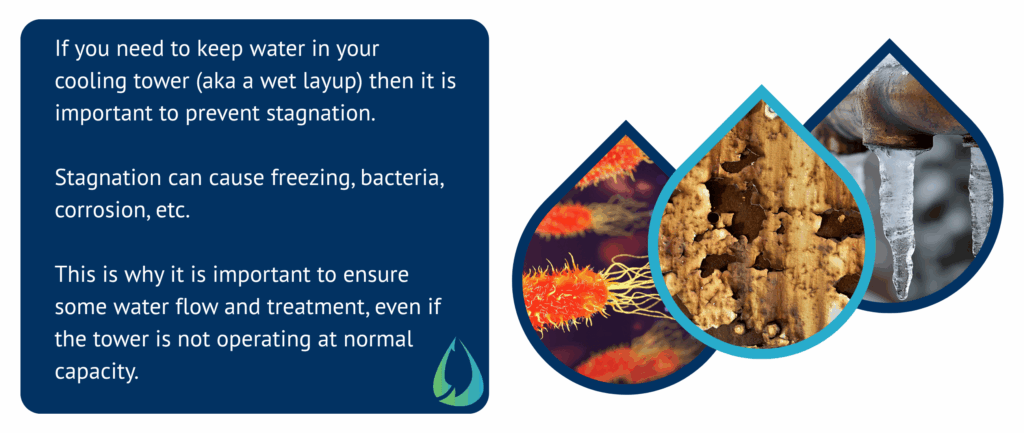
In colder months, your tower is at risk of freezing. Evaporation greatly deteriorates glycol and leaves the cooling tower system vulnerable. If you do decide to leave your cooling tower with water in it, it is important to make sure there is an active flow so freezing does not occur.
Draining to the roofline can protect exposed piping from freezing damage, but the system must be circulated at least once a week to keep inhibitor and biocide fresh and at the right concentrations. Stagnant water is always a problem, and the lack of inhibitor and biocide makes the situation worse. Anaerobic species like SRB (sulfate reducing bacteria) can gain a foothold that will cause long-term problems even when the system comes back online.
Cooling towers that remain unused or are only used intermittently will run into issues such as high levels of bacteria. If draining your cooling tower is not an option, you still will need to feed chemicals at adjusted dosages and circulate the water to prevent stagnation.
Chardon cooling tower chemical treatment products can remain active in the system even when it is not circulating, but all biocides have a certain half-life, and protection rarely lasts more than a couple of days.
Serious consideration should be given to isolating secondary components and draining them per the outline above. If draining is not possible, program the energy management system to circulate water through offline components twice daily in coordination with the biocide to help prevent biofilm formation.
If you plan to use a wet layup for the offseason, or if your system must remain ready for operation, work with your Chardon Service Technician to reduce cycles by 50% and make the necessary adjustments to the inhibitor and biocide feed rates for this period. You should also work with your Service Technician and Energy Management Program to turn on the tower circulation pump in coordination with the biocide feed schedule. This will ensure that the system receives an adequate amount of biocide to prevent the formation of biofilm.
If the system has an outside water meter or the meter is in an unheated area, it must be removed because water can accumulate in the meter and associated piping and cause the meter to rupture. Water meter removal should be a routine part of the tower lay-up procedure.
Whenever the system is drained, it is best to open the chiller heads and piping to the air to avoid a moist environment that will promote an attack on steel. If there is no time to punch the tubes until spring, it is even more important to let the system dry out. It may seem like keeping water in the system makes it easier to punch tubes, but the consequences of corrosion always outweigh the potential benefit of keeping deposits “soft.”
The CT Lay-up and Slimex B program do not interfere with your startup procedure. Simply fill the tower as usual and begin your usual operation. Mill scale problems will be reduced, and your equipment life cycle will improve.

Whether you need a wet layup, a dry layup, startup, or normal operational help, Chardon Labs is here! Our cooling tower chemical water treatment program is highly specialized. We know how to make cooling systems last and prevent costly maintenance issues. For more information about our services and to message an expert, click here.