- Jasper County
- Rensselaer
- Lake County
- Gary
- LaPorte County
- Michigan City
- Newton County
- Kentland
- Porter County
- Valparaiso
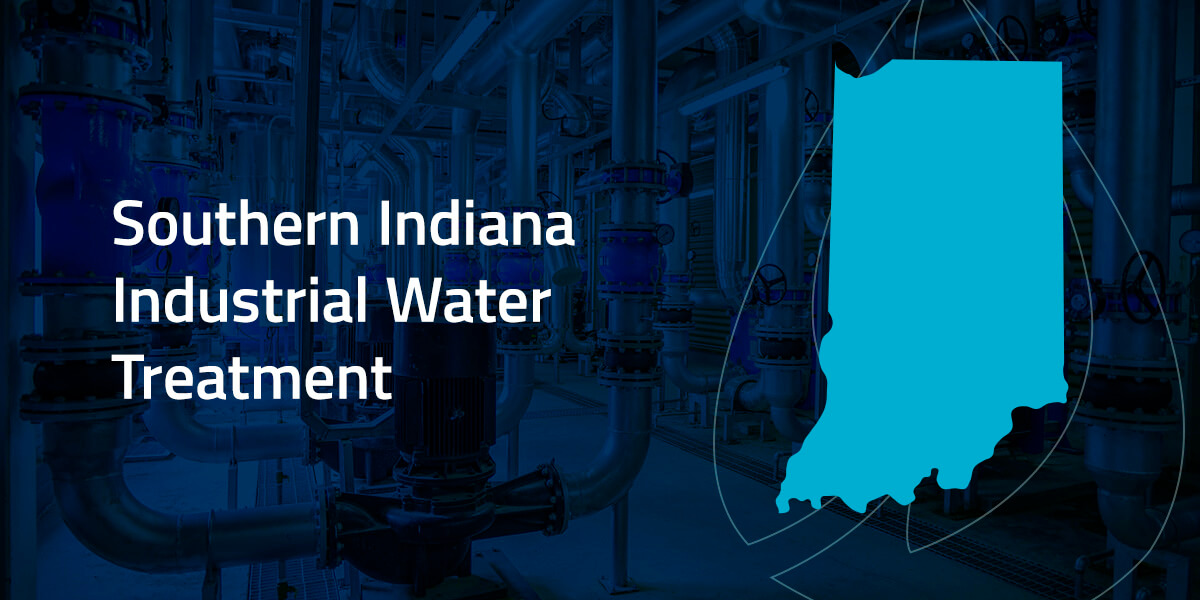
Manufacturing operations, healthcare campuses and institutional facilities throughout the region depend on reliable heating and cooling systems that cannot afford unplanned failures. Yet, many southern Indiana facilities spanning from Bloomington to Evansville face persistent water treatment challenges that impact operational efficiency.
With regional water hardness at about 10 grains per gallon (gpg), industrial systems experience excess mineral accumulation. That buildup compromises heat transfer, accelerates corrosion and drives up energy consumption.
Chardon Laboratories resolves the issues with water treatment programs that center on outcomes, not chemical consumption. We partner with facility managers who need verifiable results, transparent pricing and technicians who understand regional water chemistry.
Our Service Areas Throughout Southern Indiana
We deliver comprehensive water treatment throughout the region’s major counties:
- Vigo County
- Terre Haute
- Clay County
- Brazil
- Sullivan County
- Sullivan
- Vermillion County
- Newport
- Parke County
- Rockville
- Greene County
- Bloomfield
- Putnam County
- Greencastle
- Owen County
- Spencer
- Knox County
- Vincennes
- Daviess County
- Washington
- Martin County
- Loogootee
- Fountain County
- Convington
- Tippecanoe County
- Lafayette
- Warren County
- Williamsport
- Bartholomew County
- Columbus
- Rush County
- Rushville
- Tipton County
- Tipton
- Carroll County
- Delphi
- White County
- Monticello
- Cass County
- Logansport
- Miami County
- Peru
- Adams County
- Decatur
- Allen County
- Fort Wayne
- DeKalb County
- Auburn
- Huntington County
- Huntington
- Kosciusko County
- Milford
- LaGrange County
- Shipshewana
- Noble County
- Albion
- Steuben County
- Angola
- Wabash County
- Wabash
- Wells County
- Greenville
- Whitley County
- Columbia City
- Boone County
- Zionsville
- Brown County
- Nashville
- Hamilton County
- Noblesville
- Hancock County
- Greenfield
- Hendricks County
- Plainfield
- Johnson County
- Franklin
- Morgan County
- Martinsville
- Shelby County
- Shelbyville
- Marion County
- Indianapolis
- Clark County
- Jeffersonville
- Ohio County
- Rising Sun
- Dearborn County
- Lawrenceburg
- Ripley County
- Versailles
- Jennings County
- North Vernon
- Washington County
- Washington
- Jackson County
- Brownstown
- Orange County
- Paoli
- Lawrence County
- Bedford
- Gibson County
- Princeton
- Posey County
- Mount Vernon
- Vanderburgh County
- Evansville
- Warrick County
- Boonville
- Spencer County
- Rockport
- Dubois County
- Jasper
- Perry County
- Tell City
- Harrison County
- Corydon
- Floyd County
- New Albany
- Crawford County
- English
- Jefferson County
- Madison
- Scott County
- Scottsburg
- Switzerland County
- Vevay
Water Treatment Programs Designed for Operational Predictability
Traditional water treatment vendors structure pricing models that benefit from increased chemical and water use, which generate more chemical sales and elevated invoicing. This approach creates misaligned incentives where efficiency improvements actually reduce revenue.
Our model eliminates this conflict. Fixed annual pricing ties our performance directly to system reliability and operational efficiency. When your systems run cleaner and use less water, we both benefit from reduced operational complexity. A partnership with us provides budget certainty while delivering ISO 9000-certified service quality.
Each visit includes fully stocked service vehicles, uniformed technicians and complete chemical handling from delivery to container disposal. Electronic reporting provides documentation that is accessible through online archives whenever you need historical data.
Primary systems we maintain include:
- Boilers, where we address scale formation that restricts efficiency.
- Cooling towers, where our programs manage biological contamination and mineral concentration.
- Closed loop systems, where we protect HVAC performance against corrosion and microbial activity.
We Offer a Wide Variety of Water Treatment Services
Contact Us Today!

This site is protected by reCAPTCHA and the Google Privacy Policy and Terms of Service apply.
Boiler Water Treatment Services
Boiler reliability directly impacts facility operations, but water hardness across southern Indiana creates dynamic challenges for boiler operations. Evansville’s relatively moderate hardness of 7 to 8 gpg contrasts sharply with Bloomington’s 20 gpg or West Lafayette’s 22 gpg. This regional variation means treatment programs must consider and address specific characteristics.
These variations also produce differing scale deposits that reduce thermal conductivity, forcing boilers to consume more fuel to achieve target temperatures. The mineral layer insulates metal surfaces from the water they’re heating, which can lead to hot spots and metal fatigue. Corrosion operates similarly, with dissolved oxygen and pH imbalances attacking boiler internals and return lines.
Our programs support the continuous operation that these campuses require, maintaining environmental conditions without the service disruptions that compromise sensitive environments. Our approach to boiler water treatment in southern Indiana includes:
- Baseline assessment: Initial surveys establish current system conditions and identify the specific risks your equipment faces.
- Scale control programs: Chemical treatments modify mineral behavior to prevent crystal attachment to heat transfer surfaces.
- pH management: Balanced chemistry prevents both acidic attack and alkaline precipitation.
- Oxygen scavenging: We eliminate dissolved oxygen before it reaches critical system components.
- Blowdown optimization: Controlled blowdown cycles maintain water quality without excessive waste.
Closed Loop Water Treatment
Manufacturing facilities and institutional buildings throughout southern Indiana rely heavily on closed loop systems for process cooling and HVAC applications. While these systems fundamentally isolate water from external contamination, practical operation introduces ongoing challenges for both legacy and modern equipment.
System leaks allow fresh makeup water entry, bringing dissolved minerals and oxygen. Anaerobic bacteria colonize low-flow areas, producing corrosive metabolic byproducts, while different piping metals produce galvanic cells that accelerate localized corrosion.
The cumulative effect degrades heat transfer efficiency, increases pump energy requirements and creates leak risks at joints and fittings. Our closed loop water treatment in Southern Indiana prevents these cascading problems:
- Water analysis: Regular testing tracks iron dissolution, pH drift, conductivity changes and bacterial populations.
- Customized chemistry: Treatment formulations match your specific metallurgy and water source characteristics.
- System preparation: Flushing and chemical passivation remove accumulated debris and create protective metal surfaces.
- Performance monitoring: Regular maintenance provides ongoing verification that treatments perform as designed.
Cooling Tower Water Treatment
Cooling tower systems are essential for many regional facilities and industrial operations, but open recirculating designs are constantly exposed to airborne contamination, evaporative concentration and biological colonization.
Atmospheric dust accumulates in tower basins, and seasonal water warming contributes to optimal conditions for algae proliferation and biofilm development. As water evaporates to provide cooling, dissolved minerals become progressively concentrated until they form as scale on heat exchange surfaces.
These deposits reduce cooling capacity, restrict water flow and create ideal habitats for bacteria, including Legionella. Corrosion attacks tower components when water chemistry shifts outside protective ranges, threatening system reliability and operational safety.
Our cooling tower water treatment in southern Indiana manages these interconnected risks:
- Continuous monitoring: We track key water parameters, concentration ratios and system performance indicators.
- Scale inhibition: Phosphonate treatments prevent mineral crystallization on heat transfer surfaces.
- Corrosion protection: Multimetal inhibitors protect steel, copper and galvanized components simultaneously.
- White rust prevention: Specialized chemistry protects vulnerable galvanized surfaces during system startup and low-flow conditions.
- Microbial control: Nonoxidizing biocide programs maintain biological cleanliness without causing material degradation.
- Automated dosing: Chemical feed systems maintain precise treatment concentrations regardless of load variations.
Legionella Testing in Southern Indiana
Legionella bacteria thrive in the warm water conditions found throughout building water systems. Healthcare facilities face particularly stringent oversight, but any operation with complex water infrastructure benefits from comprehensive monitoring.
Our programs align with ASHRAE Standard 188 requirements while providing practical operational support. While complete prevention is seldom possible, our tailored solutions help provide ongoing control and support compliance through a proven framework:
- Hazard assessment: We evaluate your specific water systems to identify conditions where Legionella colonization could occur, including cooling towers, hot water systems, decorative water features and complex plumbing networks.
- Management plan development: We design water management strategies spanning temperature control, chemical disinfection, flow maintenance and monitoring schedules.
- Testing and validation: Regular sampling confirms treatment effectiveness and provides the documentation regulatory agencies expect during audits.
Why Choose Chardon Labs?
Our technicians understand regional water chemistry variations from Evansville and Bloomington to the eastern service areas. This local knowledge informs program design and troubleshooting when conditions change. Facility managers across southern Indiana partner with Chardon Labs because we offer:
- Tailored solutions: Every facility receives treatment programs engineered for its specific equipment, water challenges and operational demands.
- Pricing transparency: Predictable annual costs eliminate budget uncertainty and align our interests with your operational efficiency goals.
- Verified technical capability: ISO 9000 certification provides third-party validation of our quality, processes and service consistency.
Partner With the Local Water Treatment Specialists
If scale accumulation, equipment inefficiency or water quality concerns impact your operations, Chardon Labs provides solutions backed by ISO 9000-certified processes. Schedule a facility assessment to receive water chemistry analysis, system evaluation and individualized treatment recommendations for your specific challenges.