

Updated on 2nd June 2026
Premature equipment failure due to corrosion is a significant concern for facility managers of cooling towers, boilers and closed loop systems. Beyond the immediate repair costs, corrosion can lead to unplanned operational downtime, severe safety hazards and potential environmental regulatory fines. The key to preventing these failures lies in proactive monitoring and timely intervention.
Corrosion coupons offer a simple and effective solution, providing direct, reliable corrosion rate data. These small metal samples can provide significant insight into the health of your system and help prevent costly failures.
Contact Corrosion Coupon Experts
A corrosion coupon is a pre-weighed strip of metal, matched to your system’s metallurgy, used to measure the corrosion rate over a set period. These specimens are installed in water systems, where their uncorroded state is weighed. Then, corrosion exposure is measured over 60, 90 or 120 days and the states are compared. The observed weight loss is then converted into a standardized corrosion rate, revealing how aggressively a system’s environment is attacking metal surfaces.
Multiple corrosion types, including pitting, crevice, intergranular, stress cracking and galvanic corrosion, can occur in these environments. Corrosion coupons deliver the following benefits:
Metal corrosion is a critical threat in water systems, leading to equipment failures, unplanned shutdowns, toxic leaks and high replacement costs. Coupon testing can help mitigate these risks and extend your system’s lifespan.
A corrosion coupon testing system includes these components:
Proper corrosion coupon testing requires attention to detail at every stage. By following proper procedures, facility managers receive more accurate results.
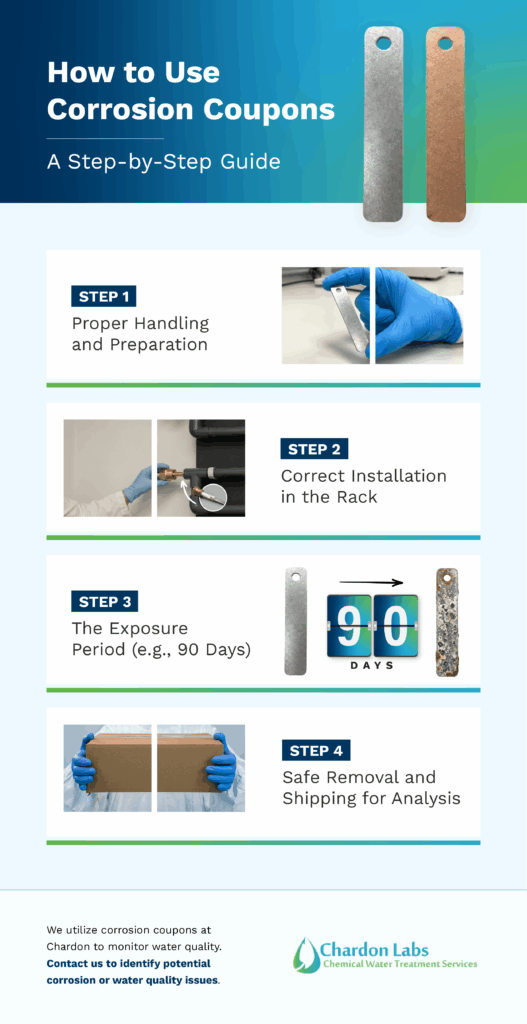
Properly handling and preparing the test coupons is essential. Use gloves or a clean cloth when touching coupons, as skin oils can contaminate the surface and skew results by acting as corrosion accelerators or inhibitors.
First, follow the information on the coupon’s package. Turn off your system and place the coupon on its holder arms. Coupons must be electrically isolated from the holder and pipe with plastic or nonconductive fasteners — doing so prevents stray electrical currents or galvanic effects between dissimilar metals from distorting the coupon’s true corrosion rate. Place the coupon where it receives full exposure to fluid flow. Finally, document installation date, location, coupon ID, preinstallation weight and material type.
Place the rack on a bypass line, ideally after the heat source, to capture realistic results. Securely fasten the rack to a wall or stand, ensuring it remains flooded at all times.
Install the coupon vertically within the rack, then switch the flow back on and maintain a rate of 3 to 5 feet per second (fps) throughout the exposure period. With flow rates below 3 fps, particulates may alter corrosion levels. Flow rates above 5 fps may erode soft alloys like brass and copper.
Ideally, water will flow from the coupon’s free end toward its attachment end, minimizing turbulence. Keep the original coupon envelopes in a dry, secure place by the rack.
Keep coupons in for the entire test period. Removing coupons mid-test can elevate corrosion and invalidate results.
90-day exposure periods are standard for routine, long-term monitoring, as periods of 90 days or longer provide more stable average rates. However, applications such as treatment program changes may warrant different exposure periods.
Maintain a constant, consistent water flow throughout this period. Remove coupons after 120, 90 or 60 days as the study specifies.

Carefully extract and dry the coupons, making sure not to displace deposited material. These deposits are essential in your evaluation. Put coupons back in their envelopes, record the removal date and send them to the lab. The corrosion analysis report comes with a written evaluation, a photograph and a rate measured in MPY.
MPY is a standard industrial unit measuring how fast a metal’s thickness decreases over time due to corrosion. Higher values denote quicker corrosion rates, while lower values indicate better corrosion control.
For reference, the MPY calculation formula is:
Where MPY = Mils Per Year, G = Weight Loss (grams), D = Metal Density (g/cm³), A = Area of Coupon (in²), T = Time (days).
Translating results into action calls for expert analysis. A coupon’s data only becomes valuable when interpreted within your system’s context. Coupons excel at measuring corrosion levels, but may not reveal localized equipment failure issues.
Coupons help predict corrosion rates for the entire system. The challenge is that flow and temperature through a corrosion coupon rack rarely duplicate conditions elsewhere in most systems. Galvanic reactions often go unmeasured because coupons are positioned away from actual metal surfaces. Low-flow areas accumulate corrosion that coupons in properly flowing bypass lines may not detect.
The most reliable indication of corrosion is total iron concentration in recirculating water. Still, many facilities require coupons as physical evidence that water chemistry alone cannot provide.
Here is what corrosion coupons can tell you:
Corrosion coupons cannot provide:
To overcome the limitations of only using corrosion coupons, combine coupon testing with real-time tools like probes.
A coupon measures past corrosion over a long period, while a probe provides real-time electronic measurement. Corrosion coupons deliver low-cost, long-term average data and physical samples for laboratory analysis. Corrosion probes provide 24/7 online monitoring for real-time, actionable insights.
Further, coupons excel at measuring weight loss, pitting depth and microbial-induced corrosion over 30- to 90-day periods or longer. Probes such as electrical resistance or linear polarization resistance types immediately detect process upsets.
Many facilities use both technologies in complementary roles — probes for day-to-day process control, and coupons for quarterly or semiannual treatment program validation.
At Chardon Laboratories, we attribute much of our long-term success to the quality of our water treatment services. Our ISO 9000-certified experts perform detailed analysis and provide you with a clear report, including the MPY corrosion rate and actionable recommendations based on the results.
When you work with Chardon Labs, you receive more than raw numbers. Our corrosion testing and analysis process assesses your system’s unique conditions.
The full analysis report includes:
Corrosion rate data lets you predict remaining metal lifespan, determine maintenance intervals and identify protective measures suited to your environment.
Corrosion coupon testing isn’t a one-off task, but an integral part of a water treatment strategy. Incorporating coupon testing into your service plan provides direct, long-term material loss measurements. This way, you can assess the effectiveness of your chemical inhibition programs.
Our fixed-price service plans bundle coupon testing, chemical treatment, regular system monitoring and technical support into a single annual cost.

Corrosion test reporting is vital for compliance, safety and asset integrity. Detailed documentation supports regulatory adherence for OSHA, EPA and industry-specific requirements. With clear records, your facility will be audit-ready.
Our reports identify degradation trends early, letting you address issues before they escalate into large-scale failures. This approach optimizes maintenance costs, targeting interventions where they deliver the greatest value.
Understanding corrosion coupon testing helps managers implement effective monitoring. Here are answers to commonly asked questions:
The right coupon material depends on which metals are present in your system. The most common materials include:
Mount less noble metals, such as carbon steel, upstream of more noble metals like copper. This approach prevents copper ions from plating onto iron coupons and causing artificially high corrosion rates.
For a closed cooling system, excellent corrosion control is generally achieved at rates below 0.5 MPY for carbon steel and under 0.1 MPY for copper alloys. Use the table below to evaluate the results from your study:
| Cooling Tower Result (MPY) | Closed Loop Result (MPY) | |||
| Corrosion Rate | Carbon Steel | Copper Alloys | Carbon Steel | Copper Alloys |
| Excellent | 1-3 | 0.1-0.25 | ≤ 0.2 | ≤ 0.1 |
| Good | 3-5 | 0.25-0.35 | 0.2-0.5 | 0.1-0.25 |
| Moderate | 5-8 | 0.35-0.5 | 0.5-0.8 | 0.25-0.35 |
| Poor | 8-10 | 0.5-1 | 0.8-1 | 0.35-0.5 |
| Very poor | ≥ 10 | ≥ 1 | ≥ 1 | ≥ 0.5 |
For more detailed information, visit our closed loop water testing page.
The best place for a corrosion coupon rack is in a sidestream bypass line, securely mounted to a wall or stable surface. Position the rack downstream from chemical injection points, allowing maintenance access while keeping coupons continuously submerged.
Install the rack in a location representative of overall system conditions. If possible, position it in a convenient, well-lit area that technicians can easily get to. For outdoor installations, protect PVC or CPVC units from direct sunlight and environmental damage.
Since 1965, Chardon Labs has been a trusted source for industrial water maintenance solutions. Our technicians address water treatment issues in cooling towers, closed loop systems, boilers and heat exchangers.
From Legionella to corrosion testing, we offer a range of water treatment services to help you maintain clean, efficient systems. Our treatment programs mitigate corrosion, scale and biological growth to reduce energy and replacement costs. You’ll receive a customized chemical water treatment program at a fixed annual price.
Ready to protect your equipment and reduce corrosion-related costs? Fill out our contact form to speak with an expert today.