
Reliable commercial steam boilers are the lifeblood of industrial operations. Facility managers must understand these powerful systems and proactively address issues such as unplanned downtime, costly repairs and compromised operational efficiency.
Familiarity with identifying and fixing steam boiler problems can maintain optimal performance, prevent facility disruptions and protect your significant capital equipment investment. Take immediate control of your boiler’s health to ensure continuous, efficient and safe operation.
Your steam boiler’s operational health directly correlates with your facility’s productivity and profitability. Ignoring subtle signs of corrosion or other distress can lead to catastrophic failures, forcing unexpected shutdowns and disrupting critical operations. These failures trigger expenses like emergency repair costs, lost revenue and penalties for missed deadlines.
Implement a rigorous steam boiler maintenance checklist and empower your team to recognize early warning signs. Partnering with a dedicated steam boiler water treatment company like Chardon Laboratories is a long-term solution. Our expertise prevents underlying issues that degrade boiler health, safeguarding your investment and ensuring smooth plant operation.
Prevent costly unplanned downtime: Boiler failure halts operations, leading to significant financial losses.
Compromise production schedules and operational efficiency: Inefficiencies like scale buildup increase fuel consumption and extend operational cycles.
Eliminate the risk of emergency repairs: Proactive maintenance and professional water treatment prevent small issues from escalating into major, budget-breaking repairs.
Protect your facility’s equipment investment: Extending boiler lifespan through diligent care is crucial for financial health.
You can’t successfully troubleshoot and maintain a commercial steam boiler until you know what issues to look for.
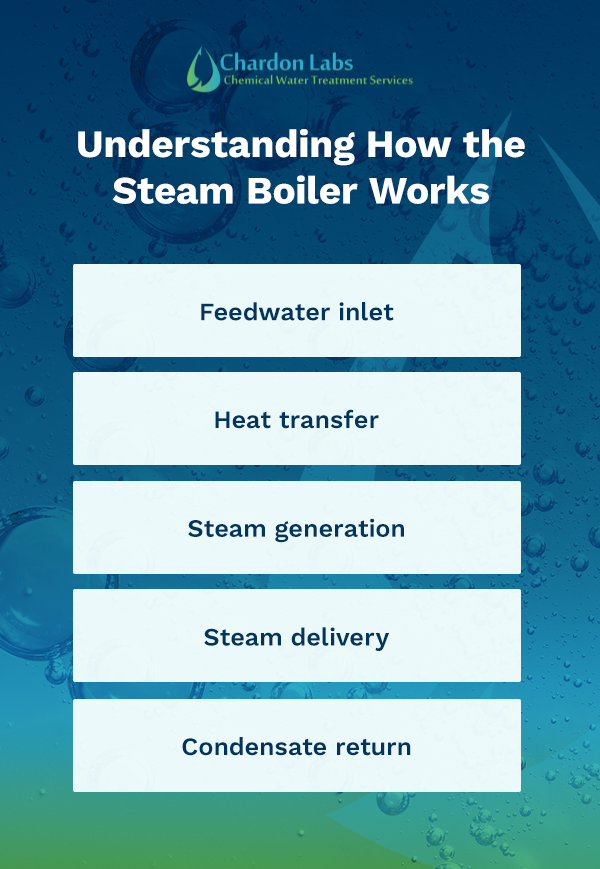
A steam boiler heats water to generate steam, which is fundamental in many industrial processes. Here’s a simplified breakdown.
Feedwater inlet: Treated feedwater enters the boiler. Its quality directly impacts boiler health.
Heat transfer: A heat source transfers thermal energy to the water.
Steam generation: Water boils, transforming into steam that collects in the boiler drum.
Steam delivery: Pressurized steam exits for use in your facility.
Condensate return: Steam cools, condenses and returns to a feedwater tank, minimizing waste.
Effective steam boiler troubleshooting and maintenance hinge on understanding critical components and safety controls. Familiarize yourself with these elements to effectively manage your system’s integrity.
The low-water cutoff is the most vital safety device on your commercial steam boiler. It detects low water level and shuts down the burner to prevent dangerous overheating and damage. Operating without a functioning LWCO is extremely hazardous. Regular testing and maintenance are mandatory. We recommend implementing a daily blowdown and scheduling professional annual inspections for your LWCO.
Maintaining stable operating pressure is essential for safety and efficiency. The Pressuretrol regulates burner operation to maintain the desired steam pressure. The steam gauge provides a visual indication of current internal pressure. Be sure to regularly calibrate and verify these devices.

The gauge glass offers a direct visual indication of the water level inside your steam boiler. This critical component allows operators to confirm the water level is within safe limits. Regular blowdown is necessary to ensure accurate readings. Consistent monitoring of the water level in your steam boiler is a fundamental daily operational task.
Proactive troubleshooting and adherence to a comprehensive steam boiler maintenance checklist are your best defenses against disruptions and costs. You can also empower your team to maintain peak performance by understanding the most common boiler problems, causes and corrective actions.
Scale buildup forms hardened mineral deposits on boiler surfaces, reducing heat transfer and leading to localized overheating, increased fuel consumption and damage. Corrosion or deterioration can manifest as oxygen pitting, caustic gouging and acid phosphate corrosion, each threatening structural integrity.
Causes include the following.
Inadequate water treatment: Untreated feedwater introduces minerals that form scale.
Dissolved gases: Oxygen and carbon dioxide accelerate corrosion.
Improper pH control: Acidic or alkaline water attacks boiler metals.
High operating temperatures and pressures: Exacerbate scale and corrosion.
Here’s how to take corrective action.
Immediate action: If you see signs of buildup or scale, schedule professional cleaning and water quality assessment. Address corrosion by isolating and repairing affected areas.
Long-term solution: Implement a customized water treatment program from experienced technicians who can diagnose root causes, prevent issues and protect equipment. This proactive approach prevents operational delays and extends capital equipment investment life.
A persistently low water level in a commercial steam boiler is a critical safety hazard, triggering automatic shutdowns via the LWCO. If unaddressed, this problem can lead to severe overheating, boiler damage or explosion.
This problem can have multiple potential causes.
Leaks: External or internal leaks, such as from a faulty blowdown valve.
Malfunctioning feedwater pump: Inability to supply adequate water.
Faulty automatic water level controls: Incorrect readings or failure to activate the pump.
Excessive blowdown: Too frequent or prolonged manual blowdown.
Priming and foaming: Water carryover with steam, leading to false high-water indication.
What can you do right away and over time?
Immediate action: Identify and rectify the cause of low water. Repair leaks, test/recalibrate feedwater controls and ensure LWCOs function.
Long-term solution: Establish daily checks for the water level in your steam boiler via the gauge glass and test LWCOs. A professional maintenance plan should include regular leak inspections. Preventive maintenance helps you avoid expensive emergency repairs and safeguards operational continuity.
Leaks in the steam system result in loss of steam pressure and energy waste. A pressure drop impacts efficiency, increases fuel consumption and causes production delays.
Here’s what usually leads to these troubles.
Corrosion: Weakens pipes, fittings and boiler components.
Poorly maintained seals and gaskets: Causes deterioration over time.
Thermal expansion and contraction: Stresses connections, leading to fatigue.
Improper installation: Leads to incorrectly tightened fittings or poor welding.
You can correct these problems in the near and long term.
Immediate action: Conduct thorough inspections to pinpoint leaks. Repair or replace compromised sections promptly.
Long-term solution: Implement routine inspections for all steam lines, valves, traps and condensate return systems. A proactive steam boiler maintenance checklist prioritizes leak detection to maintain optimal pressure and prevent escalating fuel costs. Partner with an experienced commercial steam boiler water treatment company to address internal corrosion.
Boiler sludge refers to the insoluble precipitates and suspended solids accumulating at the bottom of the boiler drum. Unlike scale, sludge is a loose deposit, but can still cause localized overheating, reduced heat transfer and blockages.
Contributing reasons include the following.
Untreated feedwater: High levels of suspended solids and hardness.
Ineffective blowdown: Insufficient or infrequent blowdown.
Chemical overdosing: Excessive use of certain water treatment chemicals.
Corrosion by-products: Metals corroding within the system.
Try making these adjustments to your schedule.
Immediate action: Increase bottom blowdown frequency to remove sludge. Consider chemical cleaning for severe cases.
Long-term solution: Optimize your water treatment program to minimize suspended solids. Regular boiler blowdown is crucial, guided by a professional steam boiler technician for an appropriate schedule based on water-quality analysis.
Foaming occurs when stable bubbles form on the water’s surface, leading to water carryon with the steam. Surging is a violent fluctuation in the gauge glass. Both conditions disrupt steam purity, damage downstream equipment and indicate water quality issues.
What’s behind the problem?
High concentration of total dissolved solids: Promotes foaming.
Presence of oil or organic matter: These act as foaming agents.
High alkalinity: Contributes to foaming.
Sudden changes in boiler load: Causes water level fluctuations.
Ineffective water treatment: Failure to remove foaming agents or control chemistry.
Practical ways to address the issue are as follows.
Immediate action: Reduce boiler load, increase surface blowdown and check feedwater for oil. Perform chemical analysis if foaming persists.
Long-term solution: Implement a comprehensive water treatment program targeting dissolved solids, organic contaminants and optimal alkalinity. Chardon Labs provides tailored services to stabilize water chemistry, eliminating foaming and surging risks and maintaining production schedules and operational efficiency.
Effective steam boiler troubleshooting addresses immediate symptoms, but true boiler system reliability hinges on results-oriented, comprehensive water treatment. Water quality directly impacts longevity, efficiency and operational costs. Ignoring water treatment leads to reactive repairs. Prioritize professional water treatment to transform boiler maintenance from a reactive burden to a strategic asset.

Preventing scale buildup and corrosion is about maintaining peak thermal efficiency and preventing catastrophic failures. Tailored water treatment programs target specific feedwater impurities, neutralizing threats. We eliminate the root causes of damage, ensure a clean boiler surface and optimal heat transfer by controlling hardness, alkalinity and dissolved gases.
Precise control over boiler water pH and alkalinity prevents acidic and caustic corrosion. Chardon Labs uses advanced chemical treatments to maintain optimal water chemistry, creating a protective environment. This detailed approach prevents aggressive chemical attacks, extending asset longevity and preventing costly unplanned downtime. Balancing your water chemistry creates a shield against degradation.
Clean boilers operate efficiently. Our commercial water treatment programs ensure maximum heat transfer by preventing scale and corrosion, thereby reducing the fuel required to generate steam.
It translates into significant operational savings. Mitigating internal damage also pushes back expensive capital replacements, preserves production schedules and enhances operational efficiency.
Steam boiler systems require specialized expertise to maintain. Chardon Laboratories is a premier steam boiler water treatment company, offering customized, comprehensive solutions that protect your investments and optimize your operations.
We’ve built our approach on decades of specialized experience, scientific rigor and dedication to our clients’ bottom line. Partner with us to transform your boiler management.
Our ISO 9000 certification demonstrates our uncompromising quality management. Every Chardon Labs technician is a certified professional in water chemistry and boiler operation. We diagnose, not guess. Our proven methodologies ensure scientifically formulated and meticulously implemented commercial water treatment programs that target root causes, providing unparalleled precision, superior results and ultimate protection for your commercial boiler assets.
Budget predictability is critical. Chardon Labs sets a fixed annual price for our water treatment services, allowing accurate forecasting and eliminating the risk of expensive emergency repairs and surprise costs. We commit to maintaining clean, efficient systems with transparent pricing. Experience financial confidence with a partner dedicated to your budget and boiler’s performance.
Thorough record-keeping and clear insights are nonnegotiable. Chardon Labs provides comprehensive electronic reporting, offering full transparency into your water treatment program and boiler conditions. Our detailed reports document chemical usage, test results and equipment status to give you instant electronic access to critical data for compliance and analysis.
Our data-driven management empowers informed decisions, optimized efficiency and adherence to regulatory standards.
Understanding commercial steam boiler maintenance is necessary for optimizing efficiency and preventing downtimes. Here are answers to questions we always hear about proactive maintenance and professional intervention.
Most industrial boilers can last about 20 to 30 years. Critically, this lifespan hinges on consistent maintenance, water quality and best practices. Without a robust maintenance checklist and professional water treatment, the lifespan shortens, leading to premature replacement. Proactive care can uncover minor issues before they become complex equipment failures.
The water level in a steam boiler is its most critical operational parameter. Shortages expose surfaces to direct flame, causing overheating and failure. Excess water leads to carryover, which damages downstream equipment. Careful monitoring of the boiler’s water level, along with functioning LWCOs, maintains safe and efficient operation.
These concerns are detrimental in different ways. Scale buildup forms hardened mineral deposits on heat transfer surfaces, reducing efficiency and causing overheating. Signs of boiler sludge include loose, muddy deposits accumulating at the bottom of the boiler drum, which can impede heat transfer and block circulation. Both necessitate effective water treatment and appropriate blowdown.
Waiting for a crisis to evaluate your steam boiler system can lead to significant downtime and replacement costs for your commercial facility. Proactive assessment prevents production delays, extends equipment life and optimizes efficiency. Chardon Laboratories offers comprehensive professional assessments to identify issues before they escalate, providing actionable insights and tailored solutions.
Our experts evaluate your water treatment program, inspect boiler conditions and recommend customized strategies for peak performance. Schedule a professional assessment today to secure your capital equipment investment and safeguard your production schedules.