
This new outbreak is unlikely to be linked to the outbreak caused in the summer of 2025. There are two new cases for residents of the apartments at 3333 Broadway, New York, NY 10031. Residents at this facility are advised to boil all potable water (drinking or cleaning) before use. The plumbing system at this large apartment complex is being tested to identify the levels of Legionella pneumonia present. A New York City Department of Health Representative said the following: “We are looking specifically at the hot water supply since Legionella likes to grow in hot water environments. It could be somewhere where the water is not circulating, the temperature is correct for legionella to amplify and grow, and then potentially circulate back out into the system.” Legionella grows best in temperature ranges from 68°F to 113°F / 20°C to 45 °C. This is why hot water systems are particularly vulnerable to more bacterial growth. Unlike the recent 2025 outbreak, this new outbreak is unlikely caused by cooling towers as this apartment building does not have one.
The New York City Department of Health has identified areas of risk around Central Harlem. Reporting from August 8, 2025 shows that 58 New Yorkers are sick with Legionnaires’ Disease, and 2 are dead from a recent Legionella outbreak caused by cooling tower(s). The following zip codes are where people are suspected of contracting the disease:
The cooling tower(s) that are likely to cause the outbreak in this area are being investigated. It is reported that the cooling towers in these suspected areas have all been tested for Legionella, and the ones with high levels of Legionella bacteria are being remediated.
According to the CDC, remediation of Legionella in cooling towers should involve disinfection with chemicals such as chlorine, flushing the system, and cleaning the system. From here, more frequent testing is necessary, as well as a chemical water treatment program to help control future outbreaks from occurring.
Cooling towers function by evaporating water droplets into the air. If the cooling tower does not have regular chemical water treatment, the pneumonia-type bacteria called Legionella can grow. This bacterium then becomes airborne and can be breathed in by nearby tenants, workers, pedestrians, etc.
Regular testing (with remediation if high levels of bacteria are found) should be performed to help prevent the bacteria from infecting nearby populations.
The American Legion is a community of United States war veterans. It is headquartered in Indianapolis, Indiana. In 1976, they hosted a convention in Philadelphia, Pennsylvania, at the Bellevue-Stratford Hotel.
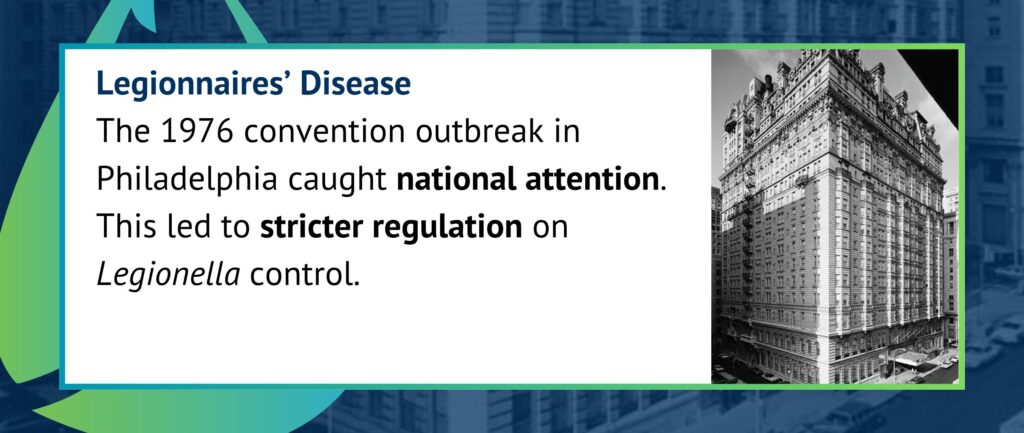
Unknown to those who attended the convention or stayed at the hotel, the Legionella bacteria were growing in the cooling tower and spreading throughout the building’s HVAC system. Over 182 cases were linked to this outbreak, and 29 people had died. This event led to increased regulations regarding cooling towers and Legionella control in Philadelphia and the United States.
Regular testing of cooling towers and plumbing systems for Legionella is important to control outbreaks like this. Testing should be done in conjunction with a chemical water treatment plan to introduce biocides to the water that help control Legionella from growing. If Legionella bacteria are detected in high amounts, it is necessary to remediate the system, so Legionella does not spread via drinking water or water droplets in the air.

Chardon Labs services several areas on the East Coast for Legionella, including Pennsylvania, New York City, New Jersey, Washington D.C., Maryland, and Delaware. To learn more or have a free survey done, contact Chardon Labs here.