
Does a Boiler Need Glycol? (Running a Boiler with No Glycol)

masthead-logo-icon
Does a Boiler Need Glycol?
(Running a Boiler With No Glycol)

A boiler can run without glycol; it will heat water and function normally. Boilers may run for years without glycol, chemicals, or other maintenance. However, a boiler that is never fed glycol will not have the same lifespan. After water, extreme cold, and years go by, maintenance issues will start to show. This is especially relevant in commercial or industrial boilers, where glycol is more important for maintenance.

Using a Boiler with No Glycol or Chemicals

Small apartments, residences, offices, and churches that have boiler systems often choose not to use glycol in their boilers. The benefits of not using glycol in a boiler for these types of buildings are saving on maintenance labor, water being a more efficient heat transfer conduit, and lower maintenance risks. 

For some, it may be okay, especially if the water in the area is soft, the boiler and pipes are not in bad condition, and the climate is not one susceptible to freezing. If any one of these factors changes, it can lead to expensive repairs and replacements.
The Benefits of Using Glycol in Boiler Systems

Not Using Glycol?
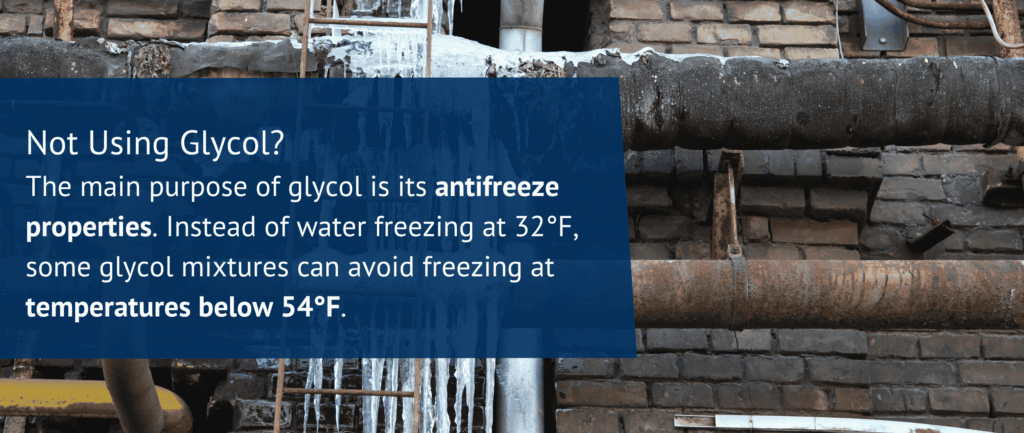
The main purpose of glycol is its antifreeze properties. Instead of water freezing at 32°F, some glycol mixtures can avoid freezing at temperatures below 54°F.
  • Antifreeze properties- Glycol mixtures can have freeze points at a much lower temperature than that of water, which freezes at 32°F or 0°C. Ethylene glycol is slightly better at freeze protection than propylene. A misconception is that pure glycol has a lower freezing point than water; it needs to mix with water in what is called a “freezing point depression”. For instance, a 60% ethylene glycol and 40% water mixture will not freeze in temperatures colder than -54°F or -48°C.
  • Corrosion resistance- Glycol intended for use in boilers usually comes in a chemical mixture with corrosion inhibitors. Corrosion inhibitors can neutralize corrosion-causing oxygen or form a protective film around the boiler’s metal surfaces. Without this, heat transfer surfaces will have a layer of rust or pitting, which significantly reduces efficiency.

High-Risk Areas for Boiler Loops to Freeze:

Boiler loops are at high-risk in outside areas, especially in colder environments. Loops filled with only water are significantly more vulnerable. Glycol can especially help if your loops are located in any of the following areas:
  • Unconditioned areas
  • No-insulation exterior walls
  • Rooftops/exterior
  • Attics or crawlspaces

Facilities with Boilers That Need Chemicals

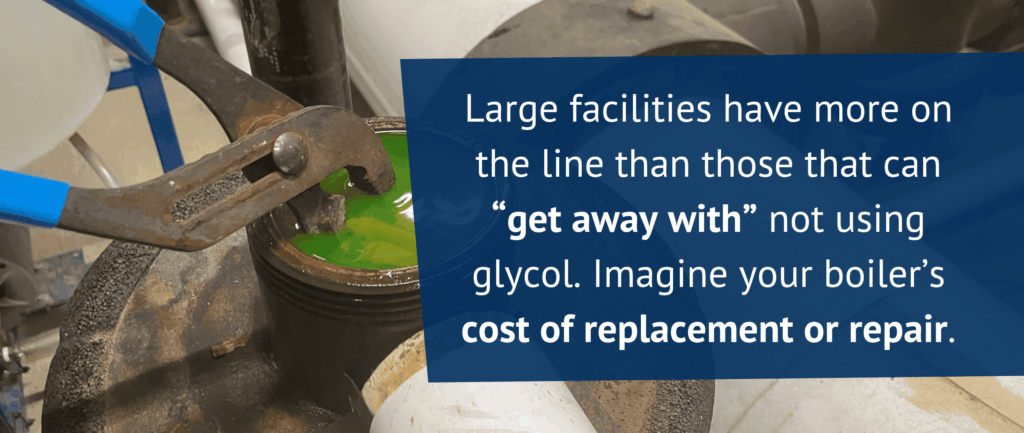
Large facilities have more on the line than those that can “get away with” not using glycol. Imagine your boiler’s cost of replacement or repair.

While smaller boiler operations, typically for residential or light commercial, may not elect to use chemicals, that will not be okay for medium-to-large-sized operations. Manufacturers, hospitals, breweries, large apartments, nursing homes, and schools should all have treatment chemicals. The usual boiler needs of a small home are not comparable to commercial or industrial boilers. Firstly, the price to install large boilers is very high, and you want to protect your valuable equipment. Secondly, the boiler requires a lot of energy costs for the gas to heat it, as well as the water usage required. Corrosion inhibitors, scale inhibitors, glycol, pH balances, antifoam agents, and neutralizing amines. These all manage the boiler’s water chemistry to reduce maintenance issues, lengthen the boiler’s lifespan, and improve efficiency.
Boiler Glycol and Chemical Services

Chardon Labs Can Help Treat Your Boiler:
Glycol
Chemicals
Equipment
Testing & Analysis
Automation
Monitoring & Reporting
sales@chardonlabs.com

Chardon Labs can test, feed, and monitor glycol and other chemicals in your boiler system. We can supply and operate the correct equipment to effectively chemically treat it. Protect your investment and remove headaches by reaching out to an expert at Chardon Labs here.

Avatar photo

Matt Welsh

Matt Welsh is the Vice President and Water Consultant at Chardon Labs. He helps consult a wide range of customers utilizing various methods of water treatment, from chemical to chemical-free approaches, large and small applications, and across a wide range of geographical influences. With 20 years of water treatment experience, including a wide range of troubleshooting and service in potable water and non-potable HVAC and industrial applications, he is an expert in water treatment chemistry for cooling towers, boilers, and closed-loop systems.

Previous ArticleClosed-Loop Glycol Replacement and Degradation