You may have heard that Legionella is spread through water, and that it can also become airborne. Could you contract Legionnaires’ disease from home or commercial air conditioning?
Get a WMP for Water Maintenance
Legionella bacteria grow in water. Stagnant water often becomes nutrient-rich with organic matter, which can feed and lead to higher concentrations of Legionella. Stagnant water also leads to the formation of biofilm to protect Legionella against the environment (including certain amounts/types of chemical treatment). It thrives well in pH ranges around 6 to 8. Legionella bacteria survive best between the temperatures of 77°F to 113°F or 25°C to 45°C. Legionella.
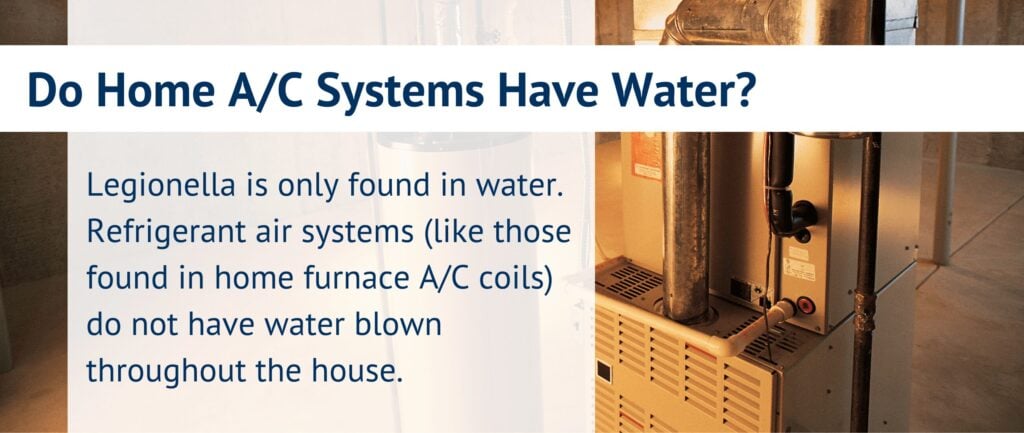
Now that we know that Legionella grows best in certain types of water, are home HVAC air conditioning systems at risk? No, you are not at risk of contracting Legionella from a home HVAC air conditioning system. However, this may not be the case for commercial or large buildings. Home air conditioners use air and refrigerant to cool the air. Legionella can only spread in the air if there are airborne water droplets, which home air conditioning systems would not produce. The same logic applies to window air conditioners, hotel/motel air conditioning units (PTACS), portable air conditioning units, and car/vehicle air conditioning.
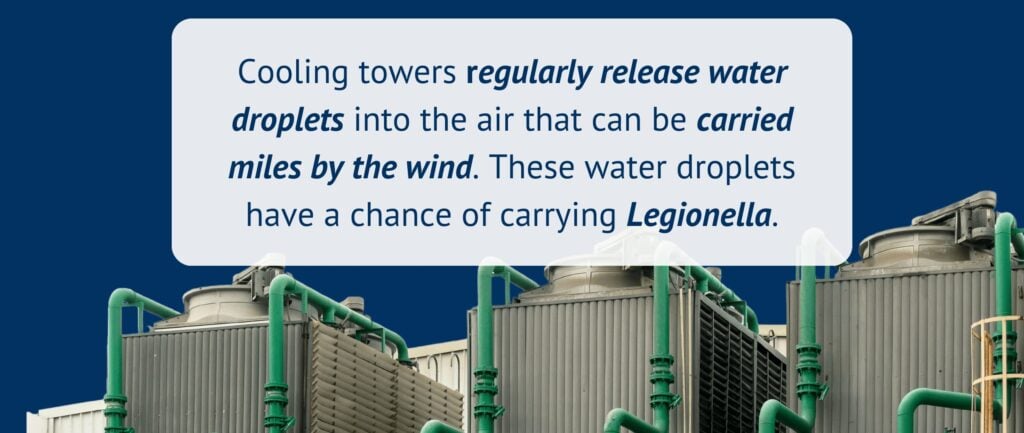
Commercial air conditioning systems work differently from the types of systems installed in residential homes. The HVAC air conditioning system will often involve a cooling tower, chiller, evaporative condenser, or other water-cooled system. These systems can grow and spread Legionella to workers, customers, and people in nearby areas. The way they grow is by typically using untreated water, providing nutrients for Legionella growth inside a cooling tower or other cooling system. The temperature ranges inside a cooling tower are ideal as well. In a cooling tower, the water will evaporate, and these aerosolized water droplets will encounter people nearby the building.
The following types of facilities are at-risk for Legionella who utilize cooling towers, evaporative condensers, and other water-cooled systems:
The solution for Legionella in cooling tower HVAC systems is to chemically treat and regularly test Legionella bacteria levels. It is recommended to feed dual biocide chemicals, which kill bacteria and the biofilm that protects them. Biocides can also work to sanitize the system. Additionally, regular testing of the cfu/mL number of bacteria in cooling tower water is necessary to ensure it is not operating with unsafe levels. Legionella is a naturally occurring bacterium, and even if all best practices are taken, it is still possible for it to emerge. As the risk of Legionnaire’s Disease becomes more well-known, many cities and states have implemented laws regarding Legionella and cooling tower systems.
Chardon Labs service managers are all ASSE 12080 certified for Legionella water safety and management. This means we understand the correct procedures for controlling, testing, and remediating Legionella. Reach out here to book a free survey or learn more about what Chardon Labs has to offer.