
Is your cooling tower scaling, and do you need to descale it entirely? Cooling tower scale can cause some serious issues, such as decreased efficiency. Ideally, the cooling tower would have a chemical water treatment program and other preventive measures done to avoid scale in the first place. Many of the methods you use to prevent scale are also how you remove it as well.
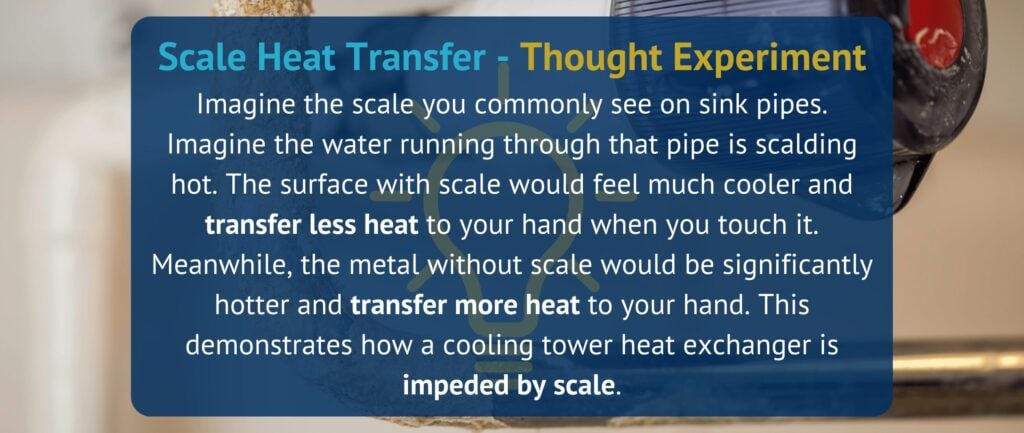
Scale remediation strategies will depend on the water chemistry of your cooling tower. Is it “hard water” with large amounts of total dissolved solids like calcium carbonate and magnesium silicate? Or is it considered “soft water” with a small amount of minerals present? In addition to total dissolved solids making water hard or soft, solubility is also another important consideration. Solubility is the point at which dissolved solids (scale) are removed from the water. Solubility increases with higher temperatures and at higher pHs. Therefore, we can take away 3 water chemistry factors that cause scale in cooling towers:
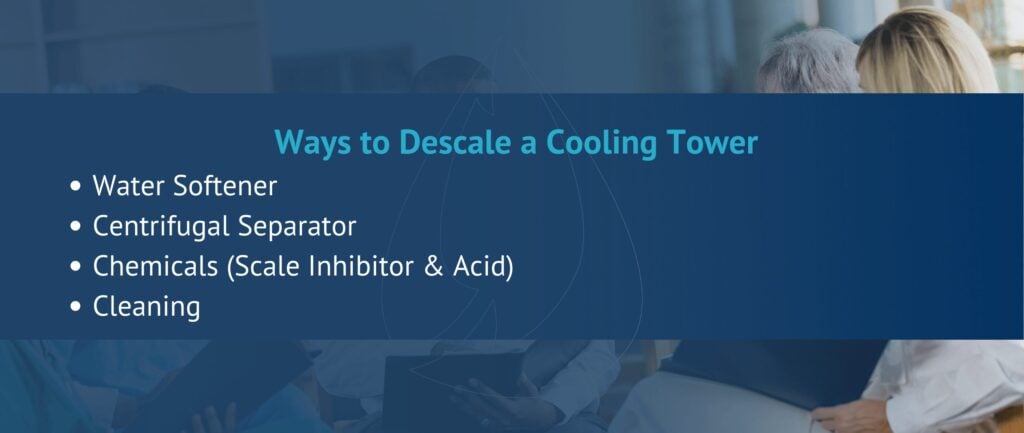
Now that we know what causes scale, the way to prevent it is to counteract these factors. High levels of hardness can be counteracted by installing a water softener. The reason water feels “softer” is that hard minerals, such as calcium carbonate and magnesium silicate, are physically removed in the water softening process. Another way to reduce water hardness is with a centrifugal separator. When water deposits float in the water, it will filter out most of the minerals. To lower water pH, acids are a useful chemical to implement as part of a chemical water treatment program for your cooling tower. Lastly, high temperatures are the one factor one may not be able to change, as the wet-bulb temperature (the coldest temperature the water can be and still be able to evaporate) cannot be lowered. Another way to reduce scale in a cooling tower is to flush the system regularly. This reduces the amount of dissolved scale minerals present in the water. Lastly, if you are needing to descale as fast as possible, it may be worth it to clean the cooling tower.
Scale inhibitors, also referred to as dispersants or deposit control agents, are the industry’s preferred chemical for removing scale in cooling towers. Scale inhibitors work by keeping minerals soluble (dissolved and unable to leave deposits). Many of these change the crystal structure of the scale to achieve this. Popular scale inhibitor chemicals for cooling towers include the following: Polymers, copolymers, phosphonates, and phosphates.
Often, cooling tower water treatment personnel will utilize acid to lower the pH / alkalinity of the water. Low pH means a lower chance of scale formation. Keeping your pH between 6.5 to 7.5 pH is ideal for scale prevention. The most utilized acid is sulfuric acid.
Chardon Labs is the leader in scale prevention; we have prevented and remediated scale deposits in thousands of cooling towers. What this means is that no matter your cooling tower’s size or system set up, we have dealt with a similar system and know how to deal with scale in yours.
We offer a scale-free guarantee and stand by our work. (Note, this is provided you maintain a minimum recommended equipment for your cooling tower). To hear more about our scale prevention or remediation service for cooling towers, talk to an expert today! We offer free site surveys to assess your specific situation.