
Oxygen present in boiler water leads to corrosion/pitting. Oxygen breaks down the metal surfaces of the boiler and can cause costly repairs or replacement. Thankfully, oxygen scavengers are an effective, proven chemical solution for this. Boiler oxygen scavengers may be referred to as boiler corrosion inhibitors. There are many useful types of oxygen scavengers with different properties. Some also passivate the metal surfaces of the boiler from oxygen corrosion. Different chemicals are food-safe, non-food safe, or toxic. Additionally, some are better suited for high- or low-pressure boiler systems; those that leave behind significant waste in the form of total dissolved solids should not be used in high-pressure boiler applications.
The following are the best types of boiler oxygen scavenger chemicals:
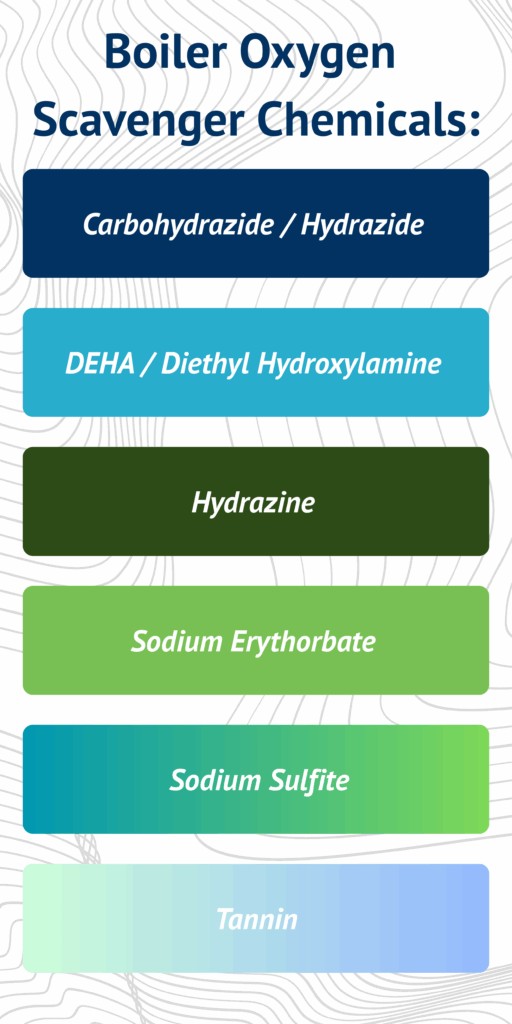
It takes a relatively long time for it to react and remove oxygen. When it reacts with and removes oxygen, it releases carbon dioxide (which becomes carbonic acid) as a byproduct. Carbonic acid will lower the pH of the boiler water and can be corrosive, so this byproduct is one negative aspect of utilizing carbohydrazide to prevent corrosion. It is also a volatile chemical.
It is quick to react with oxygen present in the boiler water. DEHA / Diethyl Hydroxylamine byproducts it creates with water include acetate, nitrogen, and water. In addition to removing water, it can also passivate the metal surfaces of the boiler. It can help lower the pH of the boiler system as the DEHA will change into dialkylamines after some time passes. It reacts quickest at high pH values. DEHA leaves behind little waste, causing less of a need for blowdowns. It is considered to have a relatively low amount of toxicity.
It is commonly used in high-pressure boilers. Unlike many other chemicals, hydrazine does not create dissolved solids (which are particularly harmful in high-pressure boiler systems). It reacts with oxygen at a slow/medium pace, and catalysts like quinones can be used to speed up the process. An advantage of hydrazine is that it passivates the metal surfaces of the boiler with a magnetite film. Also, it is a volatile chemical. One disadvantage of hydrazine that limits its use in many facilities is its significant toxicity (unlike the other chemicals mentioned here). It is important to check boiler regulations in your area and industry to determine whether hydrazine can be used.
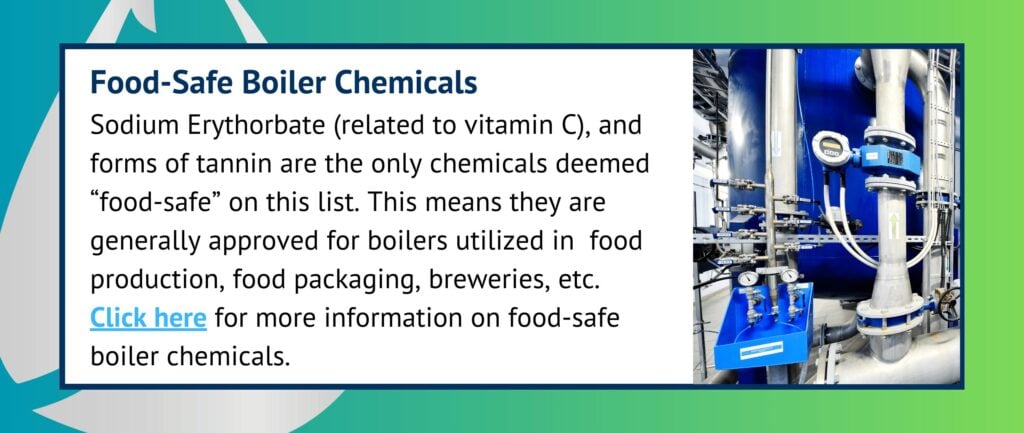
It is utilized to passivate materials susceptible to rust. It is commonly used in food-grade boiler applications, as erythorbate is just vitamin C. This and the right form of tannin are the only food-safe boiler chemicals mentioned here. Low to medium-pressure boilers can use this chemical. It is not particularly fast or slow to react with oxygen and works at a middle-ground, compared to other common oxygen scavenger chemicals. Erythorbate creates carbon dioxide as a byproduct. It passivates metal boiler parts.
Sodium sulfite is the most popular type of oxygen scavenger utilized in boilers, especially low-pressure boilers. One of the reasons it is so commonly utilized is that it is cheap and widely available. Cobalt catalysts are often used in conjunction with sodium sulfite, as it speeds up the process and amount of reaction that occurs for removing oxygen. Sulfate is made as a byproduct of sodium sulfite and can become a problem when used in high-pressure boilers. It does not have passivation properties like other chemicals mentioned here. A major disadvantage of sodium sulfite is that it is not a passivator, unlike the other chemicals mentioned.
Does not leave behind much waste when treating; therefore, fewer blowdowns are necessary to flush out chemical residue. Tangin does not rely on specific temperatures to work effectively, as other oxygen scavengers do. It is food-safe in many forms. Tannins also work to passivate the boiler surfaces, like many other chemicals mentioned here.
To determine the amount of oxygen scavenger chemical necessary to feed into a boiler, it is important to estimate the amount of dissolved oxygen currently in the boiler system. The higher the temperature, the lower the amount of dissolved oxygen present in the boiler. This is true until it reaches 194°F -212°F or 90°C -100°C, where other issues can start to occur.
Oxygen scavenger chemicals are often paired with boiler deaerators for maximum oxygen corrosion protection. Boiler deaerators have a few different purposes, including supplying water, increasing initial water temperature before it is transferred to the boiler, and removing oxygen/gases from the water. The way a boiler deaerator works is that the feedwater that enters the deaerator is superheated to high temperatures, and it separates the oxygen/gases and vents them out of the deaerator system. After this, it gets scrubbed with steam that has no oxygen and is later sprayed into a fine mist. This mist water has a very low oxygen/gas content and is then transferred into the boiler.
Chardon Labs is the leader in boiler chemicals and boiler chemical water treatment services. We work on high- and low-pressure boilers. From small boilers present in a school to large boilers in manufacturing plants, we have you covered. We do not do residential boilers currently and are completely focused on commercial boiler services. We feed oxygen scavengers on a routine basis to our current customers.
To learn more about our offerings, contact us!