
Chillers will scale if the proper prevention techniques are not used. This is because water contains minerals that deposit scale over time. Although these scale deposits can occur anywhere in the plumbing system, they are particularly harmful when the chiller’s condenser tubes become scaled up. The condenser tubes are a heat exchanger, and scale deposits insulate the surfaces of it. This makes it so more energy is required to transfer heat with the added insulation, decreasing the efficiency of the water-cooled chiller or evaporative condensed chiller system. Thankfully, there are several effective methods to prevent scale in chiller systems.
Minerals such as calcium sulfate, calcium carbonate, and magnesium are dissolved in water. They will precipitate (deposit) when the water can no longer hold onto them. This is known as scale solubility. It works similarly to how a cloud will reach a certain level of saturation before it can no longer hold it and proceeds to rain. Scale inhibitor chemicals work by disrupting scale at the scale formation stage. It prevents nucleation of the crystal cell structure, making it so that a solid material does not form. It is important to add early in the makeup water as it does not remove suspended solids and scale deposits. Phosphates and phosphonates are popular options for chiller scale inhibitors.
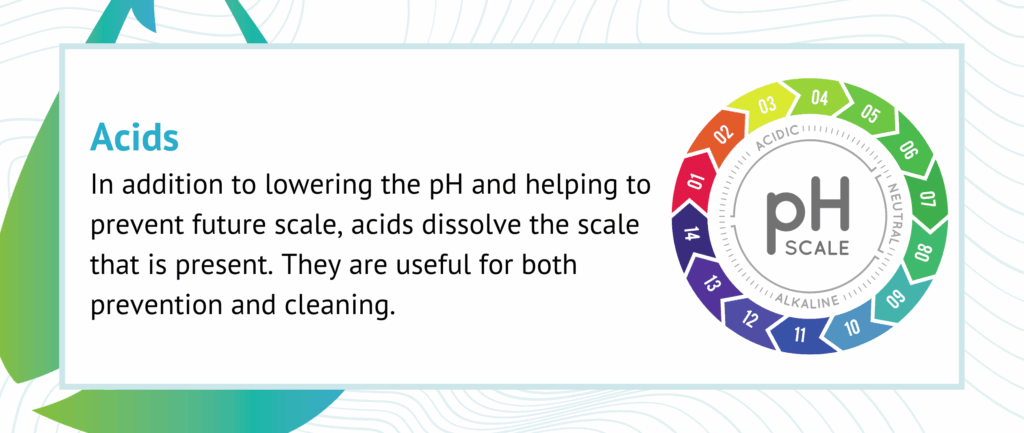
High pH levels, also known as high alkalinity, cause larger amounts of scale in chillers. Low pH (acidic) water can hold more minerals before it needs to precipitate scale deposits. Unlike scale inhibitors, acids can also be utilized to clean the scale in industrial chillers, condenser tubes, and pipes in the system. Sulfuric acid is a commonly used acid for chiller systems.
Water with a high concentration of minerals is considered to be hard water. Hard water leads to significantly more mineral scale deposits than soft water. One of the ways to remove a high percentage of minerals from water before it scales your chiller is a water softener. A commercial water softener works by transferring incoming makeup water through a layer of resin media. This resin is porous and made to absorb minerals. The resin is specially made to attract similar electron charges of common water minerals. The water travels through the resin media. The resin media will absorb the minerals, and the soft water can pass through into the chiller system. The resin media will be regenerated with salt, which removes the minerals from it to be used again on hard water.
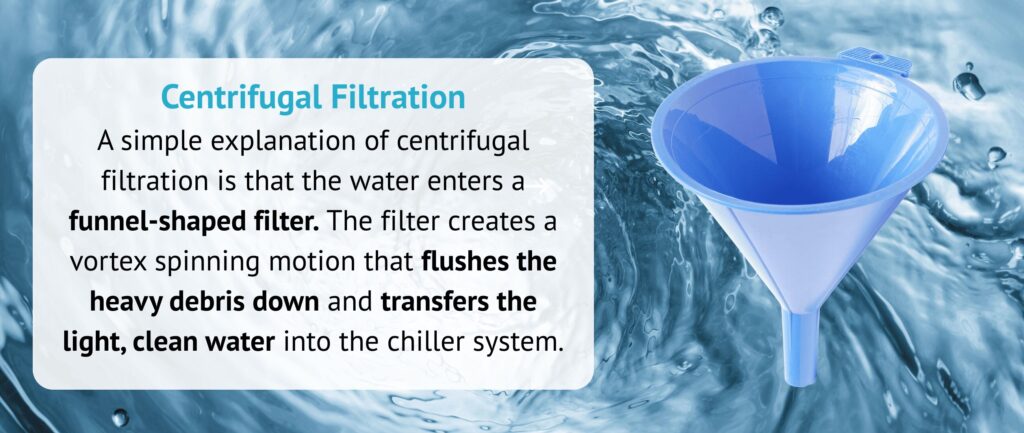
Centrifugal separators installed in a chiller system filter out suspended solids. Suspended solids include formed scale, floating in the water, that would soon be deposited inside the chiller. The way centrifugal separators function is that incoming water enters a funnel-shaped area. This funnel area uses centrifugal force to create a vortex motion in the water. Suspended solids like scale spin down the funnel. Meanwhile, the clean water remains and is transferred to the chiller, free of floating scale debris. Here at Chardon Labs, we custom-build centrifugal separators for several types of water systems, including chillers.
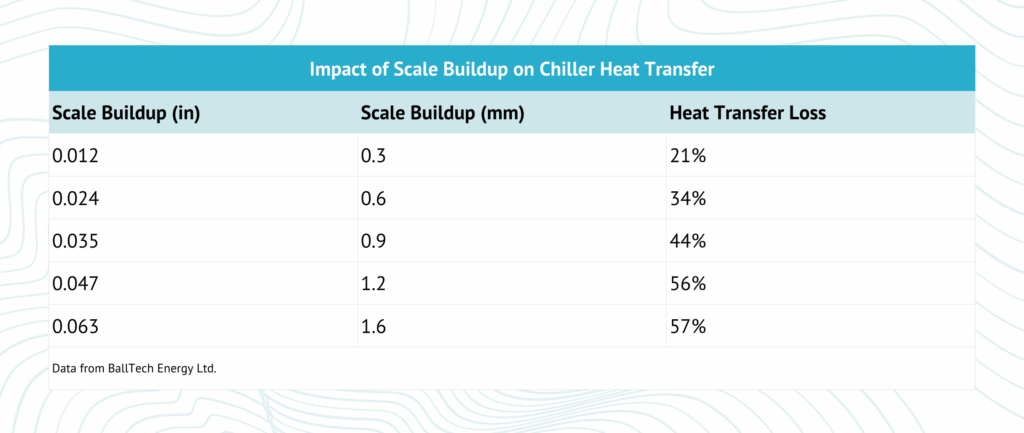
Chiller efficiency is greatly diminished by the presence of scale on its condenser tubes. Its condenser tubes are utilized for heat exchange, and insulating them greatly decreases the heat transfer; as such, more water and energy are used, adding to the cost of operating the chiller system. Just .3 mm (.01 inches) of scale can result in a 21% loss of heat transfer. 1.6 mm (.06 inches) of scale results in a 57% loss of heat transfer according to data from BallTech Energy Ltd.
It is also worth noting that high temperatures result in higher levels of scale. This is why the crucial area of a chiller, its condenser tubes, is particularly at risk, since they are transferring heat.
Regular flushing of a chiller system can help prevent scale buildup in the water. New makeup water that has just been introduced into the system can cycle through multiple times before it begins to accumulate scale. The number of times it can do this will depend on the hardness and pH of the water, mainly. If you apply the scale prevention techniques, you will not have to flush as often. This can lead to water savings.

Chardon Labs monitors chiller system water quality closely. We measure hardness, pH, temperature, and other factors to develop a chemical water treatment plan for a chiller system’s specific water. This allows us to effectively prevent, diagnose, and treat scale. For several water systems, we even offer a scale-free guarantee, provided you meet our minimum equipment standards. To learn about our scale prevention or schedule a free on-site survey, click here.