
Cooling towers work by evaporating hot water absorbed from inside the building and releasing it into the atmosphere. The water is cooled and then sent back into the building, where it will pick up more heat, and the cycle continues.
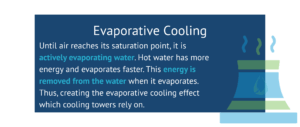
An easy way to imagine this is that evaporation cools down the hot water in a similar way to how humans sweat. Sweat is warm water released on the skin, which is then evaporated, leaving the skin at a cooler temperature. The phenomenon is evaporative cooling. Evaporative cooling is defined as the process by which water requires heat to transition from a liquid state to a gaseous state. The heat is removed from the liquid state, leaving behind a cooler surface.
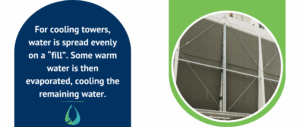
In cooling towers, water enters through a valve connected to the cool water basin. This water flows into a chiller. The chiller has a condenser that uses refrigerant to transfer it into cooled water. This cool water is then transferred to the fill of the cooling tower. At the bottom of a cooling tower, the water is spread out on a metal surface, called a “fill”, where it can evaporate. Additionally, mechanical draft cooling towers have a fan that helps accelerate this cooling process.
Water is a more efficient method of cooling a large area. Water has better heat transfer properties than air, making it less expensive to operate. However, it is important to consider that all water does not have the same properties. Hard water, alkaline/acidic water, etc., will be taken from your local water source. As it is cycled through the cooling tower, its quality will get worse as it accumulates minerals and bacteria. To combat this, it is recommended to chemically treat your cooling tower water. Scale inhibitors, corrosion inhibitors, biocides, and pH adjusters are essential chemicals to maintain your cooling tower system and allow it to operate efficiently. Your water should be tested for common issues such as Legionella on a regular basis. Additionally, the right equipment, such as chemical pumps and controllers, will make the process automated and reliable.

If you need help with the chemical water treatment of your cooling tower system, please leave a quick message to Chardon Labs, and we will set up a free survey or help with your situation.