The pH sensor is part of an instrument that measures the pH of water. Measuring water pH is especially important in heating/cooling equipment like cooling towers, boilers, loops, chillers, etc. It is made from a specially formulated, pH-sensitive glass in contact with the solution, which develops a potential (voltage) proportional to the pH of the solution. The internal reference electrode is designed to maintain a constant potential at any given temperature and serves to complete the pH measuring circuit within the solution. It provides a known reference potential for the pH electrode. The difference in the potentials of the pH and reference electrodes provides a millivolt signal proportional to pH. The most common application is the measurement of pH, which in turn controls an acid feed pump. It is important to control the pH of the water because pH impacts both scale-forming and corrosive tendencies of water. Equipment life and operating efficiency can be reduced when the pH gets too high or too low.
pH Scale
pH is defined by how much ionic hydrogen is in a substance, typically measured on a scale from 0 to 14. Low pH substances are acidic. 7 is considered to be neutral. High pH is described as being alkaline or basic. The pH scale is a logarithmic one. For example, a pH substance of 9 has 10 times more alkalinity than a substance with a pH of 8.
What Happens if my pH Sensor Fails?
The pH sensor is most often used to control an acid feed pump, which is used to manage the pH of recirculating water. If the sensor fails, the controller will not receive the correct pH information and either feed too much acid, too little acid, or perhaps no acid at all. All of these conditions should be avoided. Too much acid can accelerate corrosion. Too little or no acid can cause scaling to impact efficiency.
Does it Fail High or Fail Low?
A predictable failure pattern would help operators prepare for problems. Unfortunately, the list of problems causing sensor failure is too long to produce a pattern. Some problems cause the sensor calibration to drift high, and some cause the calibration to drift low. Routine preventative maintenance is the best approach.
When Should You Replace a pH Sensor?
The clearest clues are varying pH readings or the inability to calibrate the pH value. Physical damage is usually obvious, but even a scratch on the pH glass will cause faulty and unreliable readings. Discoloration of the reference junction can signal contamination of the junction and approaching high impedance problems.
A pH sensor should last 12-18 months, but there are some handling, maintenance, and storage practices that can shorten that considerably. Storing the sensor dry or storing the sensor in deionized water can dramatically shorten its life. The side stream piping in seasonal applications may drain, and care should be taken to avoid exposing the pH sensor to air by removing it and storing it in a pH buffer. Not cleaning the sensor can prematurely clog the reference junction, but touching or physically cleaning the sensing glass can also shorten sensor life. Solvent contamination in the water can damage sensor seals and allow the electrolyte to leak out. Freezing or boiling can crack the sensor glass. Hydrofluoric acid will attack the sensor glass, and strong caustic solutions, with a pH approaching 14, can ruin sensors in just hours. Oil contamination in the water will cause a film over the pH glass and often permanent fouling. Many different ions in solution can impact the reference junction when excessive concentrations are present, but this is generally limited to off-line contamination, and proper sensor storage can prevent reference junction problems.
High Reference Impedance
The overall impedance of the reference junction is the sum of the resistances of its components, with the largest being the liquid junction. This is due to the limited volume of the current-carrying electrolyte within the liquid junction. Coating or blockage of the liquid junction further increases the impedance of the liquid junction. The most common causes of high reference impedance are iron fouling and biofilm.
Why do Some Sensors Last Longer Than Others?
The life expectancy of a pH sensor can be shortened by a number of factors discussed above, so the absence of these factors can make some sensors last longer than others. Sensor design can impact life expectancy, too. Sensors with electrolyte volume will generally last longer than sensors with small volumes.
pH Sensor Innovations
In recent years, pH sensors have become more sensitive and better suited for maintenance. New materials are being researched, such as graphene and nanotubes, for exceptionally sensitive water monitoring. Maintenance has become easier thanks to self-cleaning, which uses a specific gel to clean itself automatically. pH sensors are used in a variety of industries in addition to heating/cooling water treatment, such as food/beverage, manufacturing, pharmaceuticals, and cosmetics.
What is Involved in Replacing the pH Sensor?
In order to replace a pH sensor, you need to pull the insulating cover back that is on the BNC connector. You then twist it counterclockwise, which removes the cable from the controller. Disconnect the solution ground spade connector. Reverse the procedure to connect the new sensor.
The Importance of pH for Water Treatment
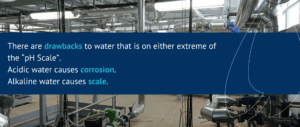
You need to be strategic when raising or lowering the pH of your system’s water. Low pH is considered to be acidic, often causing higher levels of corrosion. Alternatively, high levels of pH result in alkaline water, which promotes scale formation. Therefore, you need to reach an optimal pH range that minimizes the downsides of each. On your boiler, cooling tower, etc., your manufacturer should specify an optimal pH range for your system to operate at.
There are two types of chemicals utilized to change the pH level in your system.
Acids- Lower the pH. Hydrochloric acid and phosphoric acid are effective acid chemicals. The most common purpose of using these chemicals is to prevent scaling of your equipment. Scale forms worst in acidic environments because the solubility is too high for most of the minerals to deposit.
Alkalinity Builders- Raise the pH. Chemicals such as sodium hydroxide and sodium carbonate are commonly used to increase pH. To reduce corrosion in water, alkalinity builder chemicals are effective.
In addition to a pH addition chemical, it is important to use other preventive maintenance techniques. For instance, if you are raising the pH with an alkalinity builder, scale inhibitors, chemicals, and water softener equipment can be used as well to prevent scale deposits.
Chardon Labs Water Treatment That Balances pH Chemistry
Chardon Labs has over 60 years of water treatment chemistry experience. Balancing your pH correctly within the manufacturer’s recommendations, combining the right chemicals, installing the right equipment, remote monitoring, and regular testing result in an efficient, long-lasting system. Get in touch today to book a free site visit.
Matt Welsh
Matt Welsh is the Vice President and Water Consultant at Chardon Labs. He helps consult a wide range of customers utilizing various methods of water treatment, from chemical to chemical-free approaches, large and small applications, and across a wide range of geographical influences. With 20 years of water treatment experience, including a wide range of troubleshooting and service in potable water and non-potable HVAC and industrial applications, he is an expert in water treatment chemistry for cooling towers, boilers, and closed-loop systems.