

Chardon’s Guide to Essential Boiler Water Treatment Chemicals

masthead-logo-icon

With fuel costs continuing to rise, finding ways to optimize your facility’s consumption is key. That means properly maintaining your boiler system and its components to prevent scale buildup and corrosion that create inefficiencies, shorten equipment lifespan and increase the potential for unplanned maintenance.

Chemicals for boiler water treatment help address these issues, but the real solution is the expertise behind them. Effective treatment comes from professionals who know which compounds work best, how to dose accurately, and how to monitor performance across feed water, boiler water and condensate.

This guide explains the Chardon strategy for achieving a clean system and how our ISO-certified technicians customize solutions to deliver measurable efficiency gains. Exploring these agents and how they work together shows why expert service consistently outperforms a product-only approach.

Ask A Water Treatment Expert

The Chemistry Behind a Scale-Free Boiler System

Understanding what happens inside your boiler is the first step toward maintaining a clean, efficient system.

Your system forms deposits when sparingly soluble salts, primarily calcium carbonate and similar minerals, precipitate out of water and accumulate on heat transfer surfaces. This scale acts as a thermal insulator that prevents efficient heat transfer from the combustion chamber to the water.

Water chemistry drives this process. As internal water temperature rises, the solubility of certain minerals decreases. Calcium and magnesium compounds that remain dissolved in cold makeup water precipitate as the water heats, forming crystalline structures on tube surfaces. Once the initial scale forms, it creates footholds for additional minerals to accumulate faster. The growth accelerates over time unless you introduce the proper chemical treatment to interrupt the crystallization cycle.

The impact on your fuel consumption can be measurable and significant. Even a thin layer of scale just 1/32 inch thick can increase your consumption by between 2% and 5%, while a 1/8 inch layer wastes over 8% of fuel. These efficiency losses translate directly to higher operating costs, but the issues extend beyond energy waste. When scale insulates heat transfer surfaces, your boiler metal absorbs more heat than designed, leading to overheating, metal fatigue, and potential tube failures.

Corrosion presents equally serious risks to your operations. Dissolved oxygen in feed water reacts with iron and steel surfaces, creating localized pitting that can rapidly penetrate boiler metal. Without proper chemical treatment, these combined forces can compromise your system’s integrity, leading to unexpected shutdowns and expensive emergency repairs. The cost and complexity of removing accumulated scale is exactly why Chardon’s approach centers on proactive prevention instead of reactive damage-control.

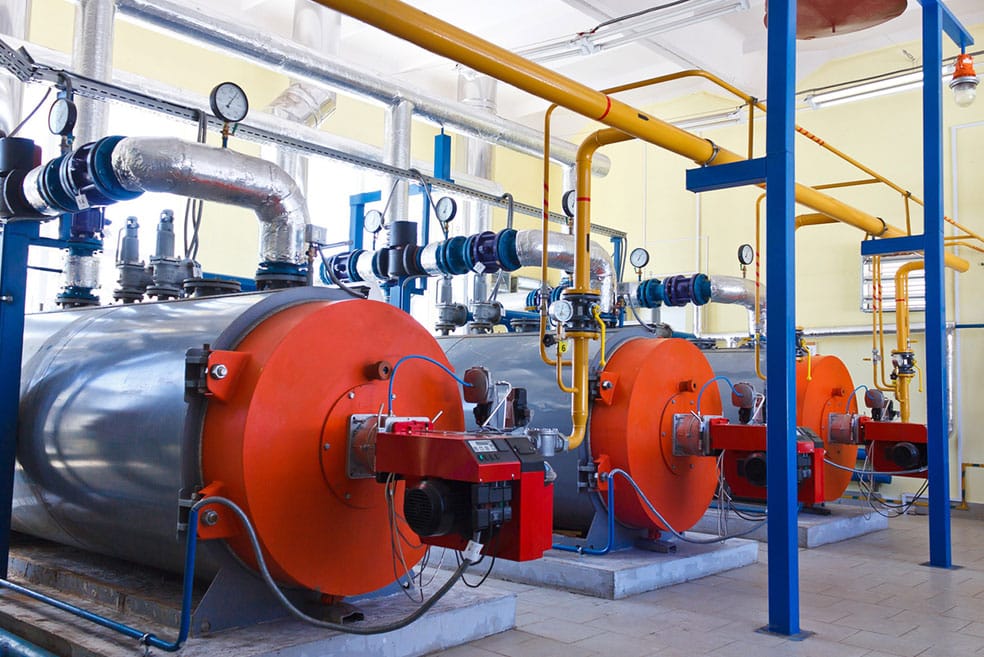
Image of more cooling tower industrial equipment that requires routine water treatment and maintenance services
chardon-logo

What Our Clients Have to Say

“Great company to work with. Very responsive to customer concerns.”

Aluminum Die

Grand Rapids, MI
quote

“I have been extremely happy with the service provided by Chardon Laboratories. Domonic has been very helpful with all aspects of our systems, especially concerning Cooling Towers. My hope is that we can continue to keep working together for a…

Retirement Community

Managing Director
quote

“The technician that comes out has been great at alerting me of things to watch for as well as answer my questions. I love it that you email me my report.”

School

Columbus, Ohio
quote

The Chemical Toolkit Chardon Experts Use

Effective boiler water treatment programs rely on multiple types of chemical solutions. Chardon draws on decades of expertise to develop the right combination for your operating pressure, water chemistry, and equipment configuration. Each chemical in our product lineup serves a specific function to keep your boiler in peak condition.

accordion-bg-icon

Oxygen scavengers perform a critical protective function by chemically reacting with dissolved oxygen before it reaches your boiler’s metal surfaces. This prevents internal pitting — a localized form of corrosion that creates small, deep cavities in metal. Unlike general surface corrosion, pitting penetrates rapidly and can cause tube failures even when your overall corrosion rates appear manageable.

Selecting the appropriate oxygen scavenger depends on your system pressure and operating conditions. For example, sodium sulfite works effectively in low- to medium-pressure boilers, reacting with oxygen to form sodium sulfate. This rapid reaction can provide reliable protection, but sulfite-based scavengers also add dissolved solids to your system — a concern in high-pressure applications where purity standards are strict.

For high-pressure systems, we often recommend volatile oxygen scavengers like diethylhydroxylamine (DEHA). These compounds react with oxygen while leaving minimal residue. DEHA and similar volatile scavengers also provide some passivation benefits, helping to form a protective magnetite film — an iron-oxide layer — on your system’s metal surfaces.

The choice between sulfite-based and volatile oxygen scavengers isn’t universal, however. The decision demands expert assessment of boiler pressure and steam purity requirements, plus whether the system includes deaerating equipment.

Proper dosing also requires an in-depth understanding of both the oxygen content entering your system and the precise chemical ratios needed for complete neutralization. While mechanical deaeration removes most dissolved oxygen from feed water, residual oxygen remains. That’s where Chardon’s expertise matters — we handle this leftover oxygen and provide a safety margin during operational upsets when your deaerator performance may temporarily decline.

Chardon’s technicians evaluate these variables during the initial system survey. The right oxygen scavenger, dosed correctly and monitored through regular testing, protects against the type of localized corrosion that causes unexpected failures. Our corrosion inhibitor solutions integrate oxygen scavenging into broader protection strategies tailored to your facility’s needs.


Maintaining proper pH throughout your boiler system, from the feed tank through the condensate return lines, protects against both acidic and caustic corrosion. Alkalinity builders raise and stabilize pH within optimal ranges. This slightly alkaline environment encourages a protective oxide film to form on your system’s metal surfaces, maximizing both lifespan and heat transfer efficiency.

Your specific pH target varies based on your operating pressure and metallurgy. For example, lower-pressure systems can typically operate safely in a wider pH range, while high-pressure boilers often require tighter control within a narrower band. The right range for your system represents a balance — alkaline enough to prevent acidic attack and promote protective film formation, but not so alkaline that caustic attack becomes a concern.

The risks of incorrect pH extend in both directions. Water that’s too acidic accelerates general corrosion, dissolving the protective oxide layer and exposing your bare metal to attack. Conversely, excessively alkaline water can lead to caustic gouging — a severe form of corrosion that creates deep grooves in your boiler’s metal, particularly in areas where steam concentrates alkalinity. This generally occurs as a result of overdosing alkalinity builders without proper monitoring. Consistent, professional monitoring prevents both and the costly damage they cause.

Yet, pH control doesn’t stop at your boiler. Steam condensate often becomes acidic due to carbonic acid formation when carbon dioxide dissolves in condensed steam. This post-boiler corrosion in condensate systems damages your return lines and heat exchangers. Chardon’s programs incorporate neutralizing amines to address carbonic acid and filming amines to provide a protective barrier on your condensate system metal surfaces.

This holistic approach — controlling pH in the boiler while protecting the entire steam and condensate circuit — reflects the reality that boiler water treatment isn’t limited to the pressure vessel. Chardon’s approach focuses on maintaining the full system through consistent monitoring and expert application of specific chemicals used in boiler water treatment at every critical point.

Scale inhibitors won’t remove existing deposits in your system, as their function is prevention. These chemicals, typically phosphonates and polymers, work by interfering with the crystallization process that allows minerals to form hard scale on your heat transfer surfaces. They distort crystal structures as minerals precipitate, keeping them dispersed in the water rather than allowing them to plate onto your boiler tubes and drums.

Different minerals form different types of scale, and the inhibitor chemistry must match the scaling threat. Calcium carbonate represents the most common scale-forming compound in many systems, but calcium sulfate, magnesium silicate, and iron deposits can also occur, depending on your water source and system conditions. Phosphonate-based inhibitors excel at controlling calcium-based scales by adsorbing onto crystal surfaces and preventing further growth. Polymer dispersants work differently, wrapping around precipitated particles and keeping them suspended in the bulk water, where you can remove them through blowdown.

The alternative to chemical scale prevention is costlier mechanical removal — shutting down your boiler, opening it for inspection, and physically or chemically cleaning accumulated deposits. In addition to the direct maintenance costs, that downtime represents lost production capacity.

Scale in your boiler also creates serious safety concerns. Metal temperatures rise beyond design limits due to the buildup’s insulating effect. This overheating weakens tube walls and increases the risk of catastrophic failures, including ruptures.

Modern polymer-based scale inhibitors are essential for maximizing heat transfer and maintaining thermal efficiency. The specific blend Chardon’s technicians select depends on your water hardness, alkalinity, and the minerals present in your makeup water supply. Some systems require phosphonate-dominant formulas, while others benefit from polymer-heavy blends that provide superior dispersion of suspended solids.

Effective scale prevention connects directly to your fuel efficiency concerns. Clean heat transfer surfaces mean maximum energy transfer from combustion gases to water. That translates to lower fuel consumption, more stable operation, and extended time between required shutdowns. Our scale prevention chemicals are formulated for these outcomes, but effective hot water boiler chemical treatment depends entirely on proper dosing and ongoing monitoring.

Carryover occurs when water droplets or dissolved solids are physically carried out of your boiler with steam. This contamination affects steam quality and can damage downstream equipment, including turbines, heat exchangers and process equipment that requires dry, pure steam. Carryover has both mechanical causes — poor separator design, excessive water levels — and chemical causes related to water surface tension and foaming.

Antifoaming agents manage surface tension to prevent foam formation and reduce the likelihood of water entrainment in steam. When your boiler water foams excessively, the foam layer can reach the steam outlet connections and carry liquid water into the steam lines. The result is wet steam that reduces process efficiency and potentially causes water hammer, erosion, and equipment damage.

Chardon uses specific antifoaming agents selected for compatibility with your overall boiler water treatment program. These compounds work at very low concentrations, requiring precise dosing to achieve the desired effect without introducing other complications. Proper application prevents carryover issues and ensures only pure, dry steam leaves your boiler, protecting both the boiler and the downstream equipment it serves.

Why the Right Chemical Is Only Half the Solution

Chemical expertise matters because boiler feed water treatment chemicals operate in a complex environment where multiple factors affect performance. Temperature, pressure, concentration, water chemistry and chemical reactions all influence outcomes. Adjusting one aspect without understanding your broader system can trigger unintended reactions or reduce treatment effectiveness.

Consider how these variables interact. When your boiler pressure rises, water temperature increases, affecting both scale-forming potential and the volatility of certain treatments. Seasonal variations in water quality, like shifts in hardness or alkalinity, necessitate adjustments to scale inhibitor dosing. Higher condensate return percentages also matter. They reduce fresh water volume, changing the concentration of total dissolved solids and potentially requiring modified blowdown protocols.

A one-size-fits-all approach fails in this context. Two facilities running similar boilers may require entirely different treatment programs based on differences in makeup water quality, operating pressure, steam purity requirements, or condensate return percentages. The chemicals are standardized, but their application must be tailored. That’s where preventive maintenance outperforms reactive approaches.

Preventive strategies center on regular testing, trend analysis, and adjustments made before problems develop. This approach maximizes your heat transfer efficiency, minimizes your fuel consumption, and significantly extends the lifespan of your pressure vessels and piping. Reactive maintenance — addressing scale, corrosion or efficiency losses only after they become apparent — costs you more in emergency repairs, unplanned downtime, and accelerated equipment replacement.

Tailored chemical programs deliver measurable value when coupled with consistent, skilled oversight. The expertise to interpret test results, recognize trends, and modify treatment strategy in response to changing conditions separates effective programs from chemical purchases that underperform. This is why Chardon’s service model emphasizes the technician’s role as much as the chemistry.

We don’t sell chemicals, we sell clean systems.

Contact Us
pexels-pixabay-62307-scaled

Related Case Studies

cta-bg02-1

Partner With Chardon for a Scale-Free System

Maintaining effective boiler water treatment requires consistent testing, accurate dosing, and real-time adjustments based on your system’s operating conditions. Chardon’s ISO 9000-certified technicians manage the entire process for you, from initial survey through ongoing monitoring.

We customize treatment programs for your specific equipment and water chemistry. Our technicians test at all critical system points, hand-deliver chemicals to eliminate freight costs and disposal issues, and provide same-day electronic reporting with full historical archives. You know exactly what’s happening in your system and why.

This approach reflects our core service philosophy and delivers on our promise of a scale-free system. Every chemical agent we use is part of a targeted strategy designed to reduce your operating costs while extending equipment life.

Contact our team to discuss your boiler system and request a free survey.

Contact Us  Call Today: (380) 224-7395