The following tips will help cooling tower maintenance personnel control scale, corrosion, and bacteria. This cooling tower water treatment article will cover the necessary equipment and best practices. Also, this is considered an intermediate-level guide. If you are just getting started with cooling tower water treatment, read this startup and initial water treatment guide.
Necessary Cooling Tower Water Treatment Tips
Chemicals to be used in the next month should be ready in the batch tanks. Additionally, for safety and organization, all batch tanks shall be labeled with the appropriate label associated with the chemical used.
All chemical pumps shall have batch tags that indicate the appropriate chemicals and their corresponding mixing ratios.
Scheduled tests should be completed and recorded in regular intervals (ex. once a week). This will ensure the water quality is consistent and help prevent water issues for the cooling tower.
MSDS (Material Safety Data Sheets) for all chemicals at the cooling tower site should be posted on or near the chemical treatment system. Many chemicals are dangerous if not handled properly, and this ensures relevant safety information is nearby.
Injectors for chemicals shall be installed on the top of the pipe, so they point down, or at least at a 45-degree angle.
Extension cords shall not be used, and the electrical code shall always be followed.
Bleed valves shall not be installed on side-stream piping with less than 15 psi of ∆P (pressure difference).
All cooling towers must be inspected at regular intervals. There are many issues that become expensive and difficult to resolve if not caught early. For example, scale can be removed quickly if there is only a thin layer; if it is a thick layer that has built up over a long period of time, it will also take a long period of time to remove it.
Stagnant cooling tower water that does not circulate for a week or longer shall have a biocide feed schedule. Stagnant water causes bacterial growth. This shall be coordinated with circulating tower water at least weekly.
Having controllers that provide conductivity bleed and water meter feed.
Dual alternating biocides, such as chlorine or bromine. This can be in either liquid or tablet form. This will help kill a greater variety of bacteria.
Blowdown shall be controlled with a bleed valve or motorized ball valve.
Side stream piping shall be 3/4″ rigid PVC or copper.
Recommended Cooling Tower Water Treatment Tips
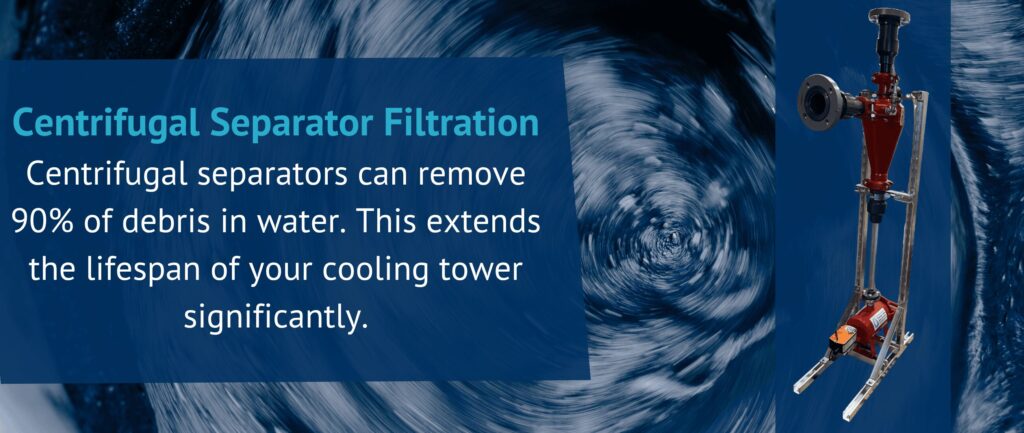
Centrifugal separators to maintain clean systems and control under-deposit corrosion. This will thoroughly filter contaminants in the water. Systems with centrifugal separators shall have pressure gauges and a pressure drop across the separator of 10-15 PSI.
Remote monitoring and alarm status updates. This will save a substantial amount of time in maintaining the system.
Upgrades to old equipment that is not functional or not as efficient as modern alternatives. You are better off replacing a malfunctioning pump as opposed to an entire cooling tower.
Legionella testing on a regular basis. Liability is on the property manager for Legionella, and staying on top of this will alleviate future issues with workers, tenants, and pedestrians.
Annual tower cleaning. This is especially important in areas with hard water or if the tower has operated without chemical water treatment for a significant period of time.
These best practices will ensure consistent results and minimize several problems. Old or improper equipment will cost more in labor and cooling tower replacement. Problems such as scale, bacteria, and corrosion need water treatment equipment that functions properly.
Chardon Labs Cooling Tower Free Survey
Chardon Labs has over 60 years of experience in treating cooling tower systems. To reduce your time spent on treating and troubleshooting waterside cooling tower problems, contact us today and schedule a free survey!
Matt Welsh
Matt Welsh is the Vice President and Water Consultant at Chardon Labs. He helps consult a wide range of customers utilizing various methods of water treatment, from chemical to chemical-free approaches, large and small applications, and across a wide range of geographical influences. With 20 years of water treatment experience, including a wide range of troubleshooting and service in potable water and non-potable HVAC and industrial applications, he is an expert in water treatment chemistry for cooling towers, boilers, and closed-loop systems.