
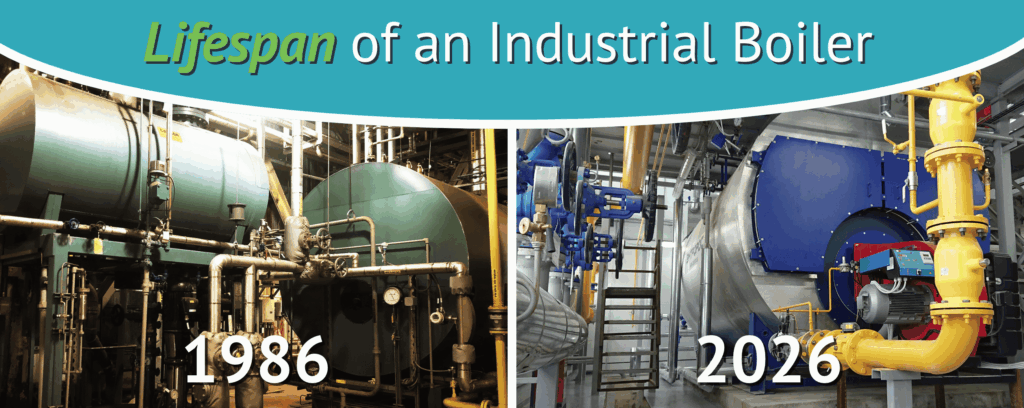
Industrial and commercial boilers can last a long time, depending on several factors. Traditionally in the 1900s, cast iron boilers were commonly utilized. Now, steel boilers are more common and there are high-efficiency models available. Maintenance is important and dramatically increases the lifespan of a boiler system.
The following are general, average lifespans. This can vary greatly depending on the particular model and other conditions.
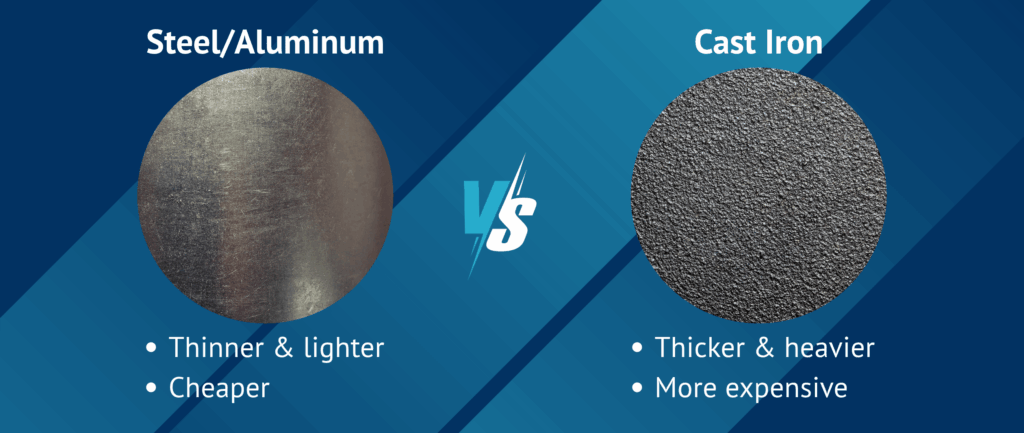
Cast iron: More durable than steel because it is thicker. It is a more traditional boiler type. Cast iron is extremely heavy and is more expensive.
Steel: Thinner and more common in new construction or replacements.
The length a boiler manufacturer is willing to offer in its warranty is often indicative of whether the particular boiler you are looking at is supposed to have a long lifespan. If a company is willing to offer a long warranty, it usually believes in the longevity of its boiler. At the very least, it tells you that you are covered for a certain number of years before covering 100% of the costs for replacement.
Additionally, their warranties often require specific maintenance to be in place to not void it. If you purchase a boiler from a brand with a good track record, that is willing to offer a long warranty, and follow all its maintenance recommendations, you will experience a much longer boiler lifespan.
For example: Weil-Mclain, a boiler manufacturer, offers a limited warranty for its cast iron boilers. It specifically warrants the cast iron parts of its boilers for 25+ years (with the amount back depending on the year the warranty is claimed). It then offers a 1-year warranty for defective parts.
Compared to its condensing boiler, which offers a 15-year warranty on just the heat exchanger (with the amount back depending on the year the warranty is claimed). The other parts have a 1-year warranty.
This demonstrates a 10+ year variation in the time Weil-Mclain is willing to warranty for two separate boiler types.
A boiler can also have a short lifespan of 10 years or a long lifespan of 45 years depending on the maintenance it has received. One of the most important maintenance tasks is water chemical treatment and pretreatment. This is especially important for steam boilers.
This is controlling the water quality of the boiler’s makeup water (the new water that comes from its local water source). Untreated water often has hardness (dissolved solids), high oxygen levels, and high alkalinity compared to treated water. To solve this, you can implement water softeners, deaerators, reverse osmosis systems, filters, and dealkalization equipment.
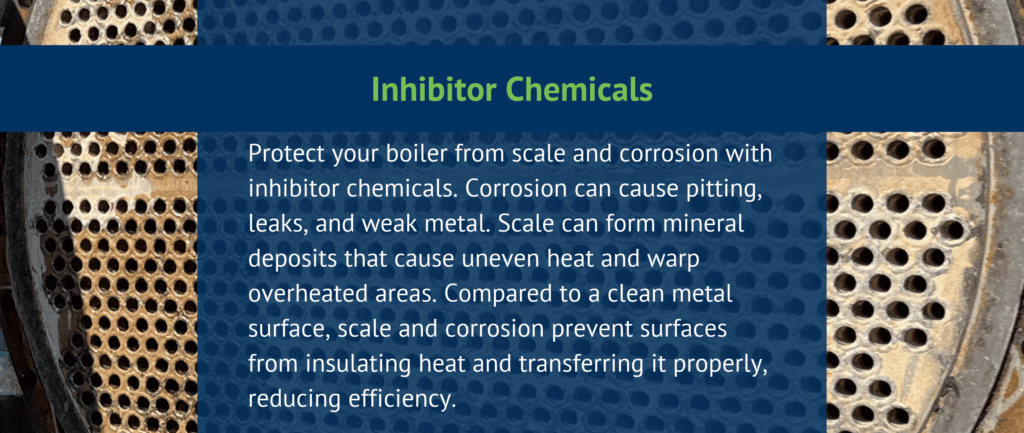
Chemically passivating your boiler is a great start if you currently do not have chemical water treatment. This involves feeding a protective film that can protect against corrosion or scale. After this, you are going to want to find out the correct routine chemical treatment program for your specific situation. Steam boilers require more chemicals than closed-loop (hydronic) boilers. Corrosion inhibitors, scale inhibitors, and pH adjusters are common boiler chemicals. In addition to lengthening your boiler’s lifespan, chemical treatment will greatly improve the efficiency of your boiler. Scale deposits and corrosion greatly reduce heat transfer because they insulate conductive surfaces. This leads to increased energy costs to transfer the same heat and water costs due to constantly having to flush your boiler system.
Consider all the costs involved in replacing a boiler system. The planning, boiler cost, installation labor, and auxiliary equipment. Now compare this to a boiler system that has had a thoughtful maintenance plan. Maintenance that doubled the lifespan of the boiler and improved its operating efficiency. This maintenance may even be required to use your warranty. The worst situation would be needing to replace a boiler after a short lifespan and not even being able to use the warranty it came with due to maintenance negligence.
The cost of a boiler system is not just its lifespan. Other factors matter, such as efficiency and maintenance costs.

Chardon Labs has been chemically treating boilers for over 60 years. Whether it is for a small school system or a large manufacturing facility, we are prepared to handle it. This history has led us to develop data-based, tailored chemical treatment plans for our customers. We report on several important water chemistry metrics such as the water’s pH, oxygen, conductivity, etc. To book a free on-site survey or receive a free quote, please get a hold of us here.

